Social Studies, Grade 6
Aligned to the Alberta Program of Studies
12 chapters, about 131 slides each. Nothing inside a course is timed — a chapter paused in November picks up where it stopped.
Opened through your school or home-school program’s licence. Sign in with the address it gave you; the course opens in our learning portal.
What you get
1576 lesson-plan slides across 12 chapters, with the teaching script on the slides themselves. No files to download. Everything runs in the browser.
How to use it
Read a chapter through before the lesson, then project it. The teaching script is printed on the slides rather than hidden in speaker notes, so review a deck before it goes on the classroom screen. At home, the same decks read as guided lessons — a parent presents, or an older learner reads straight through. Your place is saved on every device.
Who it's by
Designed by Dr. Shameeza Khan, Ed.D. — University of Portland (Ed.D.).
Twelve chapters of Grade 6 Social Studies on democracy: Athens and Rome, the Haudenosaunee Confederacy, Magna Carta, and how Canada elects, divides power and protects rights. Each chapter is a deck of twelve lessons with a chapter assessment and marking guide.
Inside RISE Learn
The course opens in our browser-based learning app. These views show a Grade 6 Mathematics example; this course’s own lessons are listed on this page.
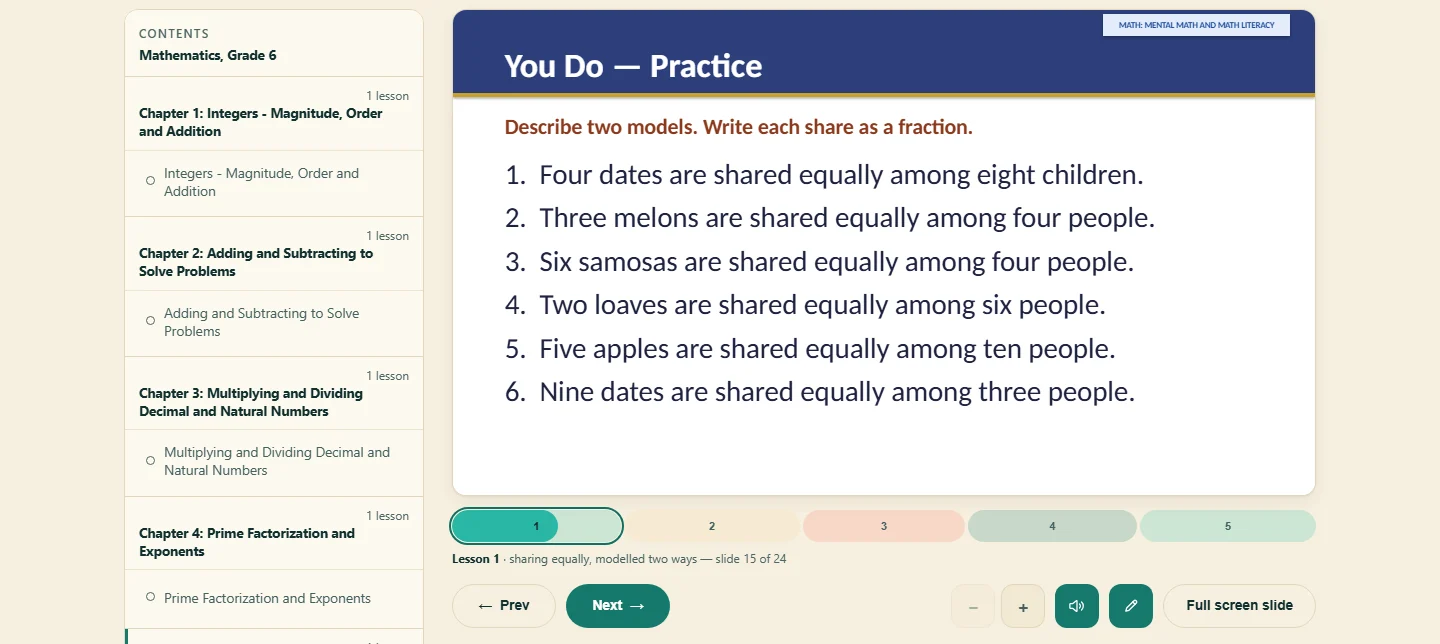
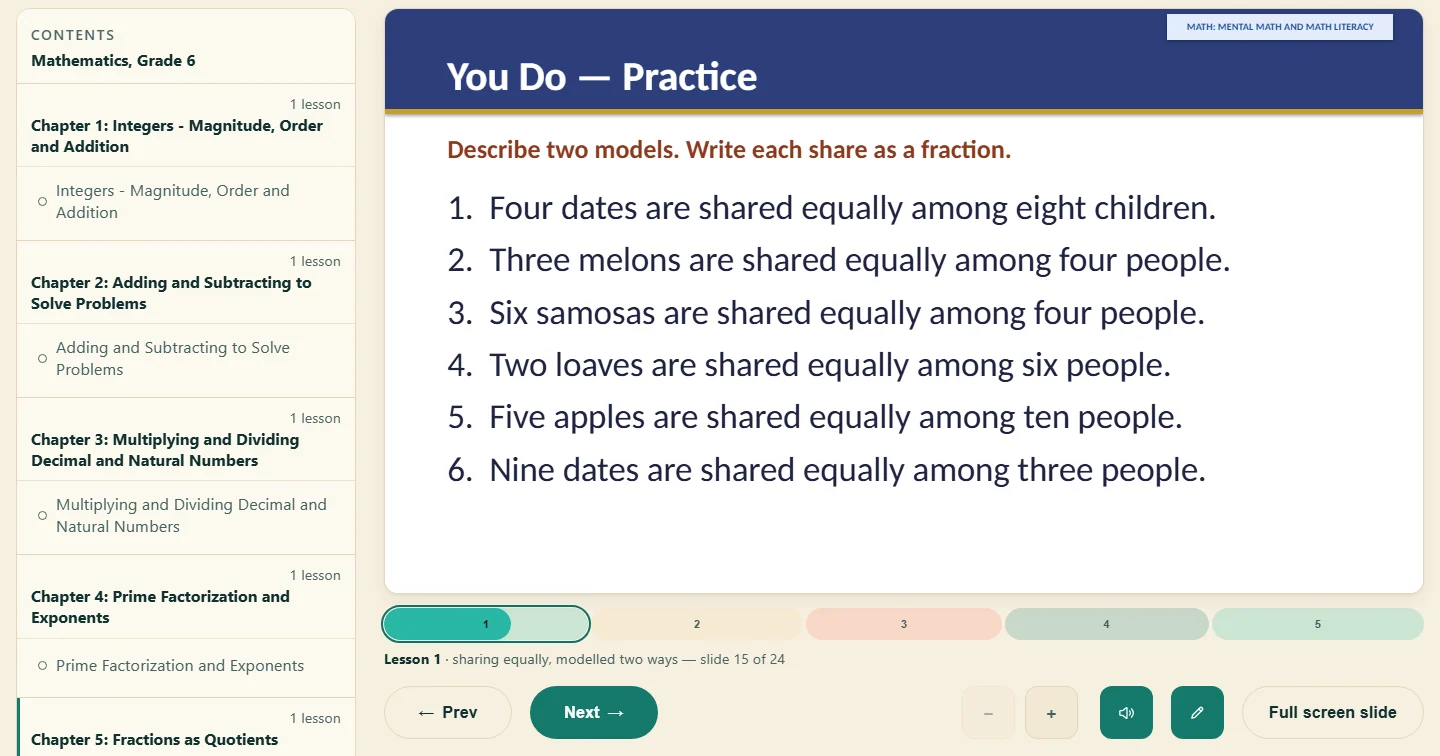
A preview
A real slide from What Is Democracy. The full deck opens when you enrol. Every slide is watermarked to the account viewing it.
What is inside
Chapter 1: What Is Democracy
- Lesson 1Who Decides?
- Lesson 2Equality Under the Law
- Lesson 3Justice
- Lesson 4Freedom
- Lesson 5Representation
- Lesson 6What a Government Does
- Lesson 7Geography Shapes Government
- Lesson 8Who Counts as a Citizen?
- Lesson 9Democracy Is Not the Only System
- Lesson 10Where Do These Principles Come From?
- Lesson 11Principles in Action
- Lesson 12Chapter Review — The Foundations of Democracy
Chapter 2: Democracy in Ancient Athens
- Lesson 1Athens Before Democracy
- Lesson 2Draco and the First Written Laws
- Lesson 3How Democracy Began in Athens
- Lesson 4Direct Democracy Day to Day
- Lesson 5The Ecclesia: The Assembly
- Lesson 6The Boule and the Lottery
- Lesson 7The Dikasteria: The People's Courts
- Lesson 8Debating and Voting on Laws
- Lesson 9The Secret Ballot
- Lesson 10Free Speech and Taking Part
- Lesson 11Three Social Classes in Athens
- Lesson 12Who Was Left Out
- Lesson 13The Limits of Athenian Democracy
- Lesson 14Chapter Review — Democracy in Athens
Chapter 3: The Roman Republic
- Lesson 1What Is a Republic?
- Lesson 2Rome Before the Republic
- Lesson 3Patricians and Plebeians
- Lesson 4What a Magistrate Was
- Lesson 5Voting for a Representative
- Lesson 6The Executive — Two Consuls
- Lesson 7The Legislative — The Senate
- Lesson 8The Assemblies
- Lesson 9The Judicial Branch — Judges
- Lesson 10Three Branches, One System
- Lesson 11Citizens and Non-Citizens
- Lesson 12The Limits of Roman Representation
- Lesson 13What Rome Passed On
- Lesson 14Chapter Review — The Roman Republic
Chapter 4: Comparing Athens and Rome
- Lesson 1How to Compare Two Systems
- Lesson 2Direct Democracy Explained
- Lesson 3Representative Democracy Explained
- Lesson 4Athens and Rome Side by Side
- Lesson 5Who Could Take Part?
- Lesson 6How Decisions Were Made
- Lesson 7The Limits — Efficiency
- Lesson 8The Limits — Representation
- Lesson 9What Each One Passed On
- Lesson 10Chapter Review — Comparison Showcase
Chapter 5: The Haudenosaunee Confederacy
- Lesson 1Who Are the Haudenosaunee?
- Lesson 2What Is a Confederacy?
- Lesson 3The Great Law of Peace
- Lesson 4The Grand Council
- Lesson 5The Role of the Chiefs
- Lesson 6The Role of the Clan Mothers
- Lesson 7How Consensus Works
- Lesson 8Consensus or Majority Vote?
- Lesson 9Collective Rights Under the Great Law
- Lesson 10Democratic Principles in the Confederacy
- Lesson 11The Confederacy Today
- Lesson 12Chapter Review — Roles and Decisions
Chapter 6: England, Magna Carta to the Bill of Rights
- Lesson 1One Ruler, All the Power
- Lesson 2England in 1215
- Lesson 3The Magna Carta, 1215
- Lesson 4The King Must Consult
- Lesson 5From Council to Parliament
- Lesson 6The Habeas Corpus Act, 1679
- Lesson 7The Bill of Rights, 1689
- Lesson 8Free Elections and Frequent Parliaments
- Lesson 9Free Speech in Parliament
- Lesson 10The Legacy of These Documents
- Lesson 11How Laws and Agreements Advance Democracy
- Lesson 12Chapter Review — Limits on Power
Chapter 7: Democracy in Canada
- Lesson 1What Canada Inherited
- Lesson 2A Constitutional Monarchy
- Lesson 3The Monarch's Representatives
- Lesson 4Parliament: Commons and Senate
- Lesson 5The Prime Minister
- Lesson 6Provinces and the Premier
- Lesson 7Three Levels of Government
- Lesson 8Tracing the Ideas Forward
- Lesson 9Evidence: Free and Fair Elections
- Lesson 10Evidence: Independent Courts
- Lesson 11Evidence: Checks and Balances
- Lesson 12Evidence: Government Transparency
- Lesson 13Evidence: Laws That Protect Rights
- Lesson 14Chapter Review — Democracy in Canada
Chapter 8: Elections and Representation in Canada
- Lesson 1Why We Hold Elections
- Lesson 2Who Can Vote in Canada
- Lesson 3Ridings: How Canada Is Divided
- Lesson 4How a Federal Election Works
- Lesson 5How a Provincial Election Works
- Lesson 6After the Votes Are Counted
- Lesson 7What an MP Does
- Lesson 8What an MLA Does
- Lesson 9Contacting Your Representative
- Lesson 10The Official Opposition
- Lesson 11Why an Opposition Matters
- Lesson 12Chapter Review — Choosing and Being Chosen
Chapter 9: Divided Powers and the Courts
- Lesson 1Why Divide Authority at All?
- Lesson 2The Constitution Act and Divided Powers
- Lesson 3What the Federal Government Decides
- Lesson 4What the Provinces Decide
- Lesson 5Where Authority Overlaps
- Lesson 6Sorting Real Responsibilities
- Lesson 7What Courts Do
- Lesson 8How Courts Interpret Laws
- Lesson 9What Judicial Independence Means
- Lesson 10How Judges Are Kept Independent
- Lesson 11Why Independence Matters
- Lesson 12Chapter Review — Divided Powers and the Courts
Chapter 10: The Canadian Charter of Rights and Freedoms
- Lesson 1What Is a Charter?
- Lesson 2Entrenched in the Constitution
- Lesson 3Freedom of Belief and Expression
- Lesson 4Freedom of Assembly and Association
- Lesson 5Guaranteed to Everyone in Canada
- Lesson 6Equality Rights
- Lesson 7Legal Rights
- Lesson 8Religious Rights in Daily Life
- Lesson 9The Rule of Law
- Lesson 10The Charter and All Levels of Government
- Lesson 11Challenging an Unjust Policy
- Lesson 12Comparing Rights Documents
- Lesson 13The Right That Matters Most to Me
- Lesson 14Chapter Review — The Charter of Rights and Freedoms
Chapter 11: Collective Rights, Limits, and Equal Dignity
- Lesson 1Rights We Hold Together
- Lesson 2Aboriginal and Treaty Rights
- Lesson 3Two Official Languages
- Lesson 4Learning in Your Own Language
- Lesson 5Publicly Funded Religious Schools
- Lesson 6No Right Is Unlimited
- Lesson 7Is This Limit Reasonable?
- Lesson 8What Discrimination Is
- Lesson 9Facing Discrimination in Canada
- Lesson 10What the Charter Lets You Do
- Lesson 11New Responsibilities, New Freedoms
- Lesson 12Chapter Review — Equal Dignity Under the Law
Chapter 12: Civic Participation
- Lesson 1What Is Civic Participation?
- Lesson 2Informal and Formal Participation
- Lesson 3A Responsibility, Not Just an Option
- Lesson 4Planning for Action: Seven Steps
- Lesson 5Step 1: Our Issue and Our Purpose
- Lesson 6Steps 2 and 3: Research and Goals
- Lesson 7Steps 4 and 5: Costs, Resources and Steps
- Lesson 8Step 6: Completing the Plan
- Lesson 9Step 7: Reflecting on the Outcome
- Lesson 10Showcase: Taking Part, All Year
Before you enrol
How do I get access?
Courses are licensed to schools and home-school programs — by grade, by subject, or the whole catalogue. Teachers and students enrol through their institution’s licence, and anyone can read a course page and its sample slides without one. If your school or home-school program is not on RISE yet, request a proposal. No card is collected anywhere. Inside a course nothing is timed: enrolment keeps one progress pointer on your account, so a course paused in November picks up exactly where it stopped.
Is there a record of completion?
Your account keeps a per-chapter record of what you have completed, which you can see any time in the portal. These courses are self-directed study; they do not carry accreditation, credit, or institutional approval.
Can I show the slides to my class?
Yes — projecting the decks to your own class from your own account is exactly what they are for. Every slide is watermarked to the account viewing it, so share your screen, not exported copies.
Will it work on a school network?
The portal is an ordinary website over standard HTTPS — no downloads, no plugins, no video CDN. If your school filter blocks it, ask IT to allow resourcesforislamicschools.com; the preview on this page is a quick way to test.
Ready to teach from it?
Opened through your institution’s licence. Nothing inside a course is timed.