Social Studies, Grade 5
Aligned to the Alberta Program of Studies
12 chapters, about 131 slides each. Nothing inside a course is timed — a chapter paused in November picks up where it stopped.
Opened through your school or home-school program’s licence. Sign in with the address it gave you; the course opens in our learning portal.
What you get
1571 lesson-plan slides across 12 chapters, with the teaching script on the slides themselves. No files to download. Everything runs in the browser.
How to use it
Read a chapter through before the lesson, then project it. The teaching script is printed on the slides rather than hidden in speaker notes, so review a deck before it goes on the classroom screen. At home, the same decks read as guided lessons — a parent presents, or an older learner reads straight through. Your place is saved on every device.
Who it's by
Designed by Dr. Shameeza Khan, Ed.D. — University of Portland (Ed.D.).
Twelve chapters of Grade 5 Social Studies on the ancient civilizations: where they grew, how they traded, governed and were organised, and what they left us. Each chapter is a deck of twelve lessons with a chapter assessment and marking guide.
Inside RISE Learn
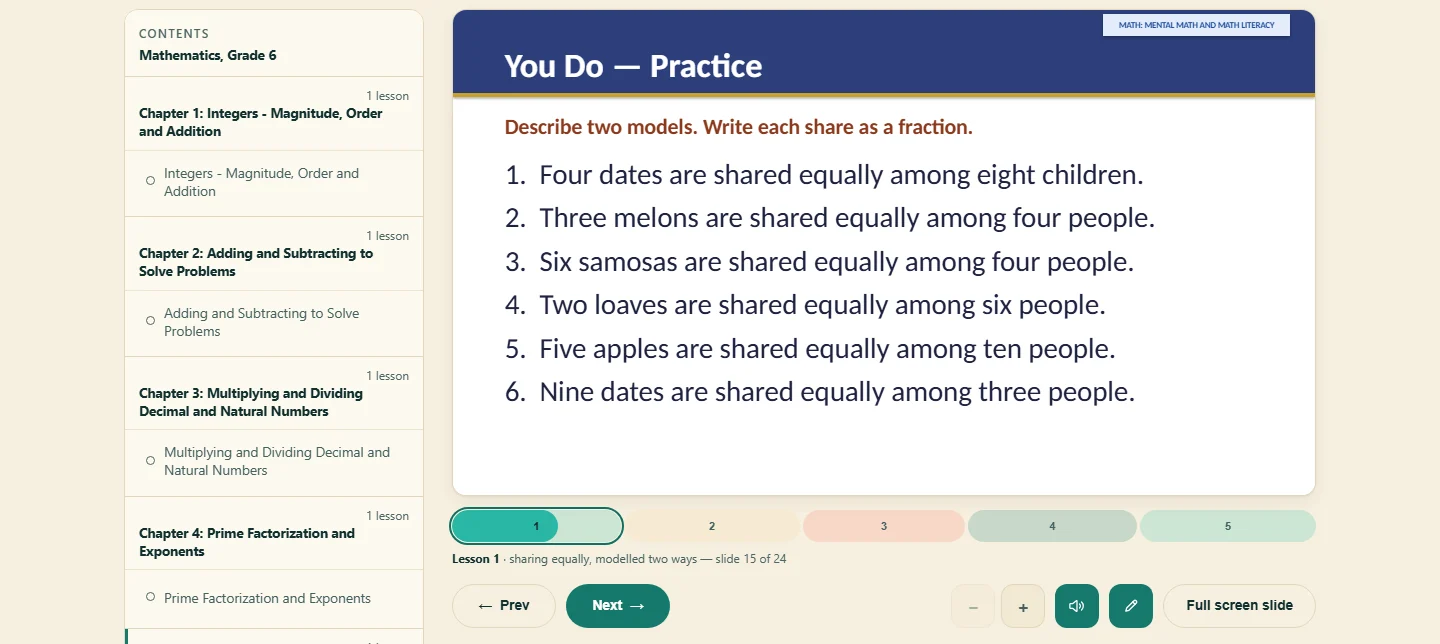
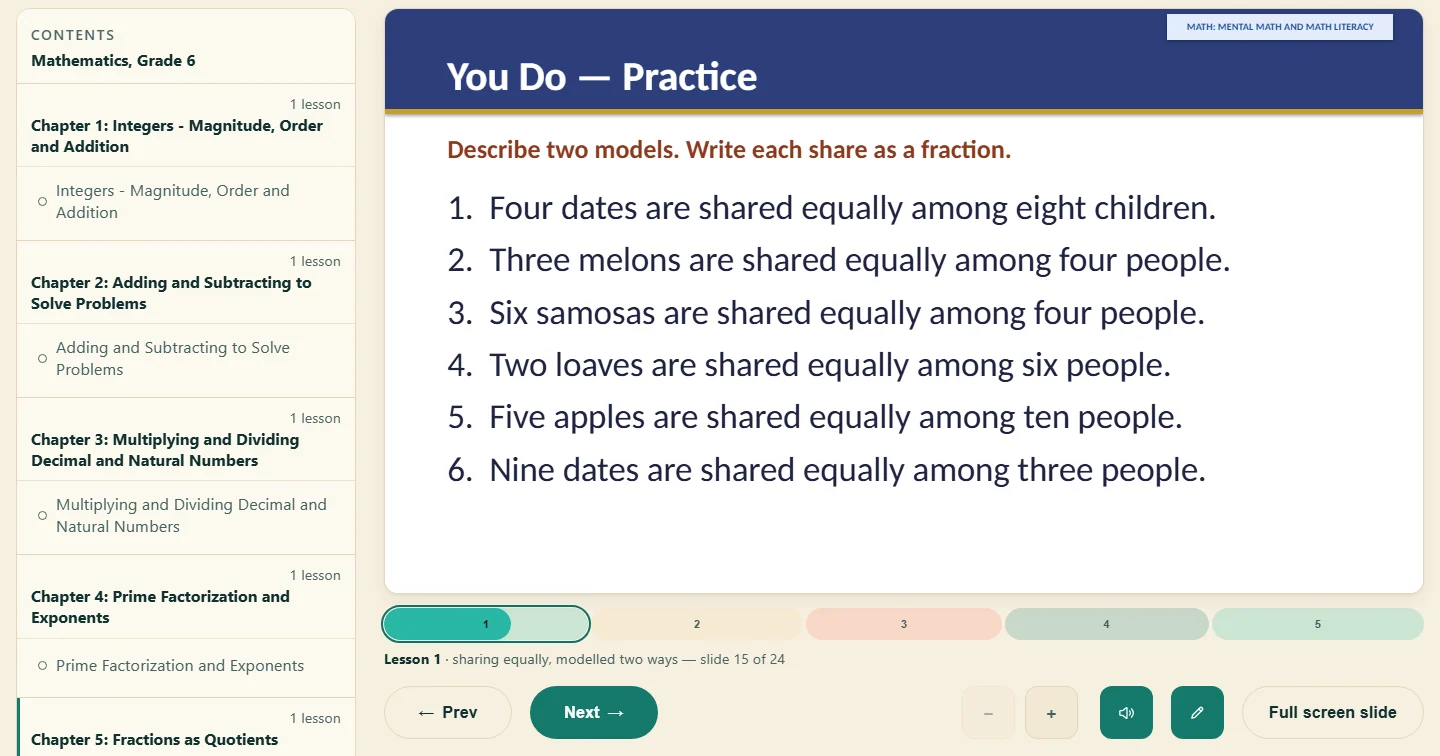
The course opens in our browser-based learning app. These views show a Grade 6 Mathematics example; this course’s own lessons are listed on this page.
A preview
A real slide from What Is an Ancient Civilization. The full deck opens when you enrol. Every slide is watermarked to the account viewing it.
What is inside
Chapter 1: What Is an Ancient Civilization
- Lesson 1Why Do We Study the Ancient World?
- Lesson 2What Makes a Civilization?
- Lesson 3Six Civilizations We Will Study
- Lesson 4Civilizations and Empires
- Lesson 5Historians and the Written Past
- Lesson 6Archaeologists and What They Find
- Lesson 7Anthropologists and Geographers
- Lesson 8Comparing the Social Scientists
- Lesson 9Primary Sources
- Lesson 10Secondary Sources
- Lesson 11Comparing Sources and Changing Interpretations
- Lesson 12Chapter Review — Thinking Like a Historian
Chapter 2: Geography and Where Civilizations Grew
- Lesson 1Why Does Location Matter?
- Lesson 2What Is a River Valley?
- Lesson 3The Nile and Ancient Egypt
- Lesson 4The Indus, the Ganges and India
- Lesson 5The Yellow and Yangtze Rivers and China
- Lesson 6Fertile Soil, Silt and Flooding
- Lesson 7Water, Climate and Farming
- Lesson 8From Farming to Settled Societies
- Lesson 9Coastlines, Seas and Bays
- Lesson 10Greece and the Sea
- Lesson 11Rome and the Mediterranean
- Lesson 12The Arabian Peninsula and Its Trade Routes
- Lesson 13Describing a Location Exactly
- Lesson 14Comparing Where Civilizations Grew
Chapter 3: Environment, Adaptation, and Building
- Lesson 1How the Environment Shapes Daily Life
- Lesson 2Slow Changes: Drought, Soil and Climate
- Lesson 3Sudden Changes: Floods, Earthquakes and Eruptions
- Lesson 4Adapt, Move, or Change the Land
- Lesson 5Adapting: Clothing, Farming and Storage
- Lesson 6Moving: When a Settlement Relocates
- Lesson 7Changing the Land: Irrigation and Canals
- Lesson 8Changing the Land: Aqueducts and Water Supply
- Lesson 9Working Out the Effects of a Change
- Lesson 10Chapter Review — Environment and People
Chapter 4: Farming, Cities, and Specialised Work
- Lesson 1What Farming Changed for Humans
- Lesson 2Irrigation: Bringing Water to the Fields
- Lesson 3Animal Power: The Ox and the Plough
- Lesson 4Better Tools, More Food
- Lesson 5What Is a Surplus?
- Lesson 6A Surplus Frees People from Farming
- Lesson 7Specialised Work: The First New Jobs
- Lesson 8From Village to City
- Lesson 9What a City Needs to Keep Working
- Lesson 10Trade Begins with Surplus
- Lesson 11Skill: Linking Farming to the Growth of Cities
- Lesson 12Chapter Review — Farming, Cities and Work
Chapter 5: Markets, Money, and Taxes
- Lesson 1What Is an Economy?
- Lesson 2Trading Without Money: Barter
- Lesson 3Markets: Where People Met to Trade
- Lesson 4The First Forms of Currency
- Lesson 5Why Money Works Better Than Barter
- Lesson 6Weights, Measures and Honest Trading
- Lesson 7Storing Valuables: The First Banks
- Lesson 8What Are Taxes?
- Lesson 9What Ancient Taxes Paid For
- Lesson 10Taxes Then and Now
- Lesson 11From Ancient Markets to Modern Money
- Lesson 12Chapter Review — Markets, Money and Taxes
Chapter 6: The Great Trade Routes
- Lesson 1Why Trade Went Beyond the Market
- Lesson 2Land Routes and Water Routes
- Lesson 3The Silk Road
- Lesson 4The Royal Road
- Lesson 5Across the Sahara
- Lesson 6Goods, Food and Spices
- Lesson 7Ideas Travel Too
- Lesson 8Medicine, Paper and Gunpowder
- Lesson 9The Risks of Long Journeys
- Lesson 10Mapping the Great Trade Routes
- Lesson 11What Expanding Trade Changed
- Lesson 12Chapter Review — The Great Trade Routes
Chapter 7: How Ancient Societies Were Governed
- Lesson 1What Is Government, and Why Do Societies Need One?
- Lesson 2Who Holds the Power — One, a Few, or Many?
- Lesson 3What Is an Authoritarian Government?
- Lesson 4Monarchies: Rule by a King or Queen
- Lesson 5Dictatorships: Rule by One Strong Leader
- Lesson 6Claiming Power from the Heavens
- Lesson 7Claiming Power Through Family
- Lesson 8Claiming Power Through Force
- Lesson 9Why People Followed — Tradition
- Lesson 10Why People Followed — Stability and Fear
- Lesson 11Keeping Power Once You Have It
- Lesson 12Chapter Review — How Power Was Held
Chapter 8: Social Classes and Social Systems
- Lesson 1What Is a Social System?
- Lesson 2Hierarchy and the Social Pyramid
- Lesson 3The Highest Class
- Lesson 4What Decided Your Class?
- Lesson 5The Middle Groups
- Lesson 6Farmers and Labourers
- Lesson 7Enslaved People in Ancient Societies
- Lesson 8Could People Change Class?
- Lesson 9Comparing Two Social Classes
- Lesson 10Patriarchal Social Systems
- Lesson 11Matriarchal Social Systems
- Lesson 12Egalitarian Social Systems
- Lesson 13How Gender Influenced Roles
- Lesson 14Chapter Review — Class, Power and Gender
Chapter 9: Empires Persia, Greece, Rome, and the Arab Empire
- Lesson 1What Makes an Empire Grow?
- Lesson 2Growing by Conquest
- Lesson 3Growing by Trade
- Lesson 4The Persian Empire
- Lesson 5The Royal Road
- Lesson 6Greece: City-States and Alexander
- Lesson 7What Greece Spread
- Lesson 8Rome: From Republic to Empire
- Lesson 9How Rome Governed Its Provinces
- Lesson 10What Rome Built to Hold the Empire
- Lesson 11The Arab Empire: Rise and Extent
- Lesson 12Learning in the Arab Empire
- Lesson 13Comparing Two Empires
- Lesson 14Chapter Review — How Empires Held Power
Chapter 10: African Empires
- Lesson 1Where in Africa Were These Empires?
- Lesson 2The Kingdom of Kush
- Lesson 3Axum and the Red Sea Trade
- Lesson 4When One Empire Ends and Another Begins
- Lesson 5Ghana and the Gold and Salt Trade
- Lesson 6Mali: Wealth and Power
- Lesson 7Timbuktu, a Centre of Learning
- Lesson 8The Songhai Empire
- Lesson 9Ife and Its Art
- Lesson 10The Kingdom of Benin
- Lesson 11Comparing Two African Empires
- Lesson 12Chapter Review — The African Empires
Chapter 11: Legacies Innovations That Still Shape Us
- Lesson 1What Is a Legacy?
- Lesson 2Writing Systems Then and Now
- Lesson 3Agriculture: The Innovation That Fed Cities
- Lesson 4Architecture: Building to Last
- Lesson 5Calendars and Measuring Time
- Lesson 6Trade, Currency and Economics
- Lesson 7Literature and Philosophy
- Lesson 8Mathematics and Science
- Lesson 9Systems of Decision Making
- Lesson 10The Idea of Rights and Freedoms
- Lesson 11Tracing an Innovation Through Time
- Lesson 12Why Civilizations Rise
- Lesson 13Why Civilizations Fall
- Lesson 14Chapter Review — Legacy Showcase
Chapter 12: Active and Informed Citizens
- Lesson 1What Is an Informed Citizen?
- Lesson 2What the Ancient World Teaches Us: Technology
- Lesson 3What the Ancient World Teaches Us: Trade and Money
- Lesson 4Systems That Worked and Systems That Failed
- Lesson 5Why One Source Is Never Enough
- Lesson 6Comparing Perspectives on an Issue
- Lesson 7Investigating an Issue Using Many Sources
- Lesson 8Ways Citizens Take Action
- Lesson 9Planning Our Class Action
- Lesson 10Showcase — Our Year and Our Action
Before you enrol
How do I get access?
Courses are licensed to schools and home-school programs — by grade, by subject, or the whole catalogue. Teachers and students enrol through their institution’s licence, and anyone can read a course page and its sample slides without one. If your school or home-school program is not on RISE yet, request a proposal. No card is collected anywhere. Inside a course nothing is timed: enrolment keeps one progress pointer on your account, so a course paused in November picks up exactly where it stopped.
Is there a record of completion?
Your account keeps a per-chapter record of what you have completed, which you can see any time in the portal. These courses are self-directed study; they do not carry accreditation, credit, or institutional approval.
Can I show the slides to my class?
Yes — projecting the decks to your own class from your own account is exactly what they are for. Every slide is watermarked to the account viewing it, so share your screen, not exported copies.
Will it work on a school network?
The portal is an ordinary website over standard HTTPS — no downloads, no plugins, no video CDN. If your school filter blocks it, ask IT to allow resourcesforislamicschools.com; the preview on this page is a quick way to test.
Ready to teach from it?
Opened through your institution’s licence. Nothing inside a course is timed.