Social Studies, Grade 4
Aligned to the Alberta Program of Studies
12 chapters, about 125 slides each. Nothing inside a course is timed — a chapter paused in November picks up where it stopped.
Opened through your school or home-school program’s licence. Sign in with the address it gave you; the course opens in our learning portal.
What you get
1501 lesson-plan slides across 12 chapters, with the teaching script on the slides themselves. No files to download. Everything runs in the browser.
How to use it
Read a chapter through before the lesson, then project it. The teaching script is printed on the slides rather than hidden in speaker notes, so review a deck before it goes on the classroom screen. At home, the same decks read as guided lessons — a parent presents, or an older learner reads straight through. Your place is saved on every device.
Who it's by
Designed by Dr. Shameeza Khan, Ed.D. — University of Portland (Ed.D.).
Twelve chapters of Grade 4 Social Studies, from the explorers and New France to Confederation and how Canada is governed. Each chapter is a deck of twelve lessons with I Do, We Do and You Do stages and a chapter assessment with a marking guide.
Inside RISE Learn
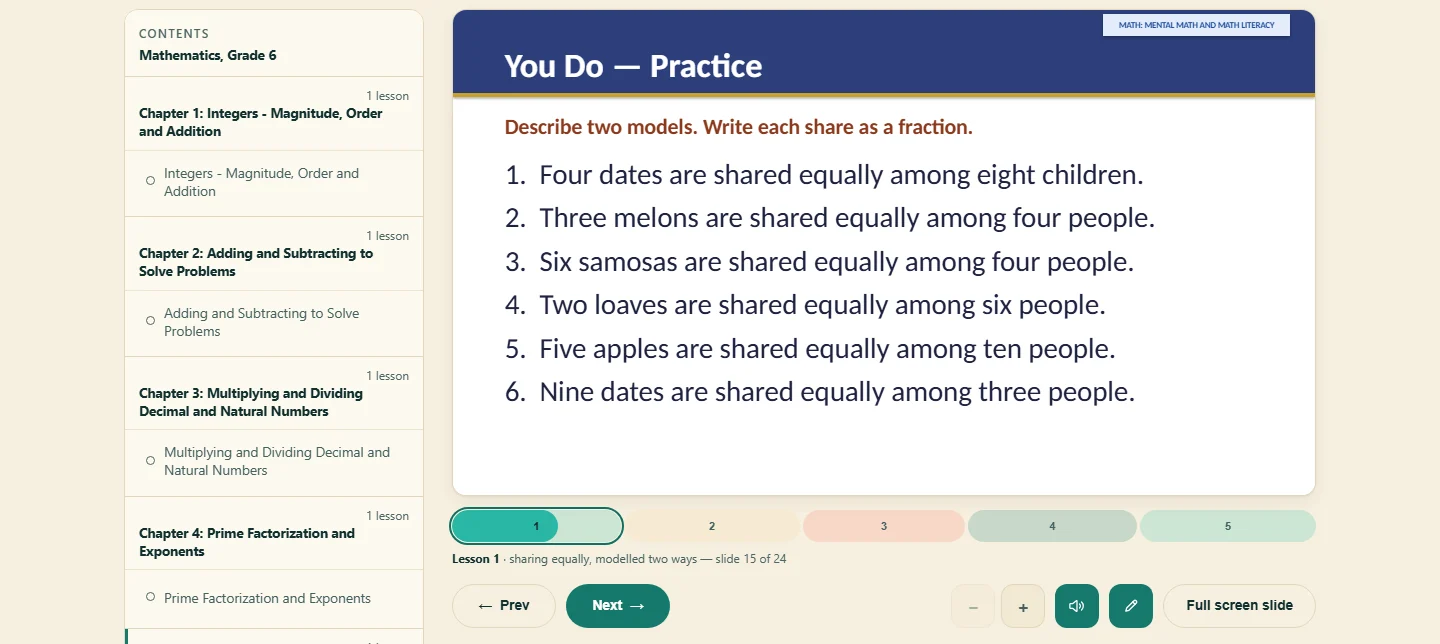
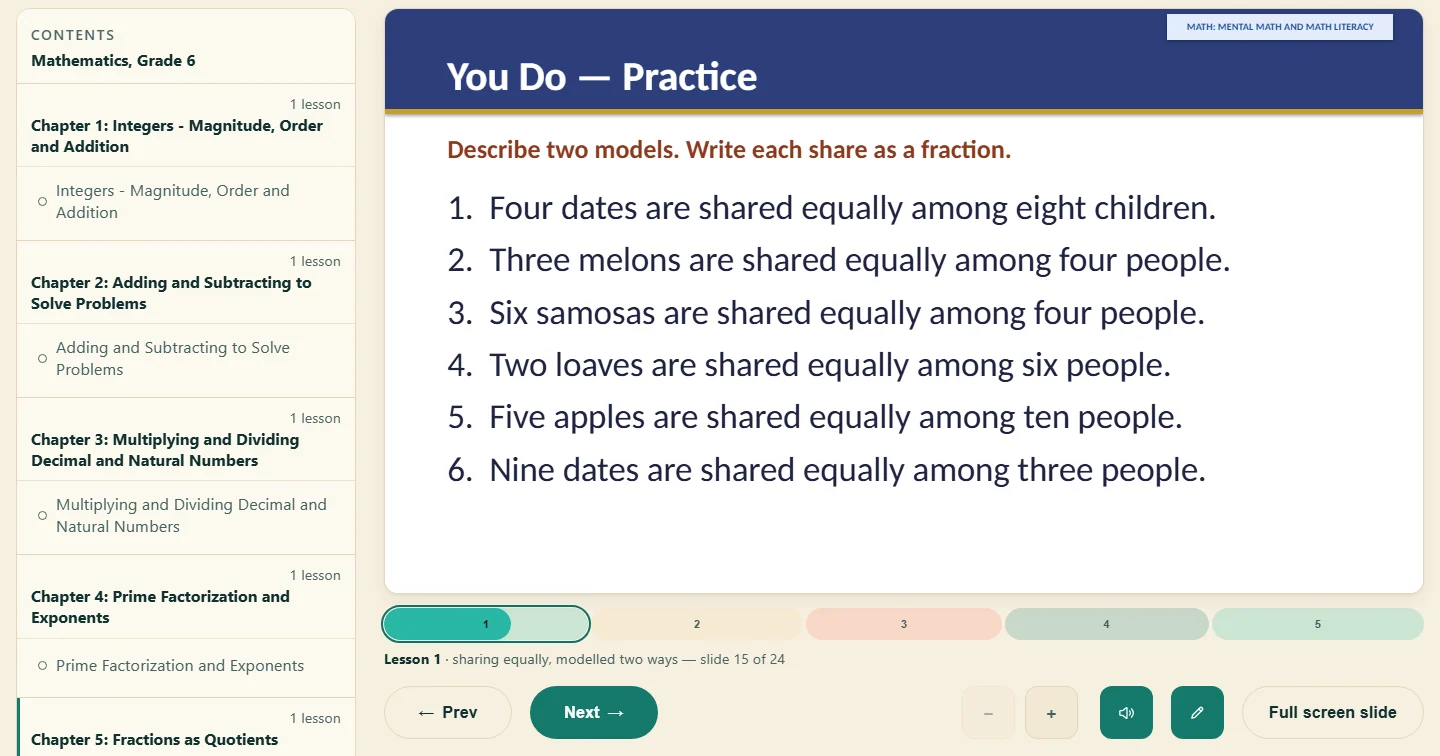
The course opens in our browser-based learning app. These views show a Grade 6 Mathematics example; this course’s own lessons are listed on this page.
A preview
A real slide from Explorers and Early Contact. The full deck opens when you enrol. Every slide is watermarked to the account viewing it.
What is inside
Chapter 1: Explorers and Early Contact
- Lesson 1Why Did People Explore?
- Lesson 2The Land Was Already Home
- Lesson 3Giovanni Caboto Reaches the Coast
- Lesson 4Jacques Cartier and the St. Lawrence
- Lesson 5Following One Explorer's Travels
- Lesson 6Pierre Du Gua de Monts
- Lesson 7Samuel de Champlain
- Lesson 8Comparing Reasons for Exploration
- Lesson 9First Meetings
- Lesson 10The Two Row Wampum
- Lesson 11Living Side by Side
- Lesson 12Chapter Review — Explorers and Early Contact
Chapter 2: New France - Settlements and Colonies
- Lesson 1What Is a Colony?
- Lesson 2Port-Royal, 1605
- Lesson 3Quebec City, 1608
- Lesson 4Trois-Rivières, 1634
- Lesson 5Montreal, 1642
- Lesson 6Champlain, Governor of New France
- Lesson 7Three French Colonies
- Lesson 8Britain and the Thirteen Colonies
- Lesson 9Empires and Land Already Lived On
- Lesson 10Why Colonists Came — Land and Work
- Lesson 11Why Colonists Came — Freedom and Adventure
- Lesson 12Building a Settlement Was Hard
- Lesson 13A Colony and Its Home Country
- Lesson 14Chapter Review — Settlements and Colonies
Chapter 3: Living in the Colonies
- Lesson 1France Comes to the Land
- Lesson 2Daily Life in a Settlement
- Lesson 3Leading and Governing a Colony
- Lesson 4Religion in the Colonies
- Lesson 5Schooling in the Colonies
- Lesson 6Health Care and Healing
- Lesson 7Work, Land and Family Life
- Lesson 8Furs Sent Across the Ocean
- Lesson 9Lumber, Farms and Minerals
- Lesson 10Home Country and Colony
- Lesson 11Newcomers Before Confederation
- Lesson 12Chapter Review — Living in the Colonies
Chapter 4: The Fur Trade
- Lesson 1What Was the Fur Trade?
- Lesson 2Supply and Demand Across the Ocean
- Lesson 3What Was Traded Each Way
- Lesson 4Modelling the System of Exchange
- Lesson 5The Hudson's Bay Company
- Lesson 6The North West Company
- Lesson 7Competition Pushes North and West
- Lesson 8Trading Posts as Meeting Places
- Lesson 9Forts as Warehouses and Homes
- Lesson 10Trappers, Guides and Interpreters
- Lesson 11Clerks, Coureurs des Bois and Voyageurs
- Lesson 12The Women Who Held the Trade Together
- Lesson 13How the Fur Trade Changed Communities
- Lesson 14Chapter Review — The Fur Trade
Chapter 5: Wars, Treaties, and Changing Boundaries
- Lesson 1What Is a Treaty?
- Lesson 2France and Britain: Rivals
- Lesson 3When War in Europe Reached the Colonies
- Lesson 4The Treaty of Utrecht, 1713
- Lesson 5Acadia Under British Control
- Lesson 6The Conflict Over New France
- Lesson 7The Treaty of Paris, 1763
- Lesson 8What Changed for the People of New France
- Lesson 9French Colonists Under British Rule
- Lesson 10British Acts to Rule the Colonies
- Lesson 11Reading a Map of Pre-Confederation Canada
- Lesson 12Comparing Maps Before and After 1763
- Lesson 13Describing the Shift in Control
- Lesson 14Chapter Review — Wars, Treaties, and Boundaries
Chapter 6: The Royal Proclamation and the Quebec Act
- Lesson 1What Is an Act, and Who Passes One?
- Lesson 2The Royal Proclamation of 1763
- Lesson 3First Nations as the Original Inhabitants
- Lesson 4The Right to Self-Government
- Lesson 5Nation to Nation: Making Treaties
- Lesson 6First Nations and the Crown
- Lesson 7Why the Royal Proclamation Still Matters
- Lesson 8The Quebec Act of 1774
- Lesson 9French Language and Religious Rights
- Lesson 10A Foundation for Bilingualism
- Lesson 11Two Acts, Three Groups
- Lesson 12Chapter Review — Two Acts That Shaped Canada
Chapter 7: Loyalists, the War of 1812, and Migration
- Lesson 1A New Country Next Door
- Lesson 2The Treaty of Paris, 1783
- Lesson 3Who Were the Loyalists?
- Lesson 4Where the Loyalists Settled
- Lesson 5Upper Canada and Lower Canada
- Lesson 6Why the Crown Divided the Province
- Lesson 7Why the War of 1812 Began
- Lesson 8Fighting for a Shared Purpose
- Lesson 9The War of 1812 and Relationships
- Lesson 10The Great Migration, 1815 to 1850
- Lesson 11Migration and the Balance of Power
- Lesson 12Britain Ends Slavery, 1833
- Lesson 13The Underground Railroad
- Lesson 14Chapter Review — Newcomers and a Changing Map
Chapter 8: Rebellions and the Province of Canada
- Lesson 1Who Held the Power?
- Lesson 2Growing Dissatisfaction
- Lesson 3Rebellion in Lower Canada
- Lesson 4Rebellion in Upper Canada
- Lesson 5The Durham Report
- Lesson 6One Province of Canada
- Lesson 7Equal Representation
- Lesson 8One Official Language
- Lesson 9When People Push for Change
- Lesson 10Chapter Review — Rebellions and the Province of Canada
Chapter 9: Confederation
- Lesson 1What Would Joining Together Mean?
- Lesson 2Why the Colonies Started Talking
- Lesson 3The Fear of American Expansion
- Lesson 4The Railway Argument
- Lesson 5The Charlottetown Conference
- Lesson 6The Quebec Conference
- Lesson 7The London Conference
- Lesson 8The Fathers of Confederation
- Lesson 9Francophone Perspectives
- Lesson 10Anglophone Perspectives
- Lesson 11Comparing the Two Perspectives
- Lesson 12The British North America Act, 1867
- Lesson 13Why the BNA Act Still Matters
- Lesson 14Chapter Review — Confederation
Chapter 10: How Canada Is Governed
- Lesson 1What Government Does
- Lesson 2A System with British Roots
- Lesson 3The Parliamentary System
- Lesson 4What Is an MP?
- Lesson 5The House of Commons
- Lesson 6The Prime Minister
- Lesson 7The Crown and the Governor General
- Lesson 8How a Law Is Made
- Lesson 9Three Levels of Government
- Lesson 10How the System Has Changed
- Lesson 11Why the BNA Act Still Matters
- Lesson 12Chapter Review — How Canada Is Governed
Chapter 11: Rights and Responsibilities
- Lesson 1What Does Citizenship Mean?
- Lesson 2What Is a Right?
- Lesson 3The Right to Be Treated Equally
- Lesson 4What Is a Freedom?
- Lesson 5What Is a Responsibility?
- Lesson 6Contributing to My Community
- Lesson 7Respecting the Rights of Others
- Lesson 8Voting Is a Responsibility
- Lesson 9Every Right Has a Responsibility
- Lesson 10My Rights and My Responsibilities
- Lesson 11Why Rights Need Protecting
- Lesson 12Chapter Review — Rights and Responsibilities
Chapter 12: Consolidation and Showcase
- Lesson 1Our Year on One Timeline
- Lesson 2How Canada's Boundaries Changed
- Lesson 3The People in Our Story
- Lesson 4Choosing My Showcase Topic
- Lesson 5Researching My Showcase Piece
- Lesson 6Rehearsing and Improving
- Lesson 7The Grade 4 Social Studies Showcase
- Lesson 8Looking Back on the Year
Before you enrol
How do I get access?
Courses are licensed to schools and home-school programs — by grade, by subject, or the whole catalogue. Teachers and students enrol through their institution’s licence, and anyone can read a course page and its sample slides without one. If your school or home-school program is not on RISE yet, request a proposal. No card is collected anywhere. Inside a course nothing is timed: enrolment keeps one progress pointer on your account, so a course paused in November picks up exactly where it stopped.
Is there a record of completion?
Your account keeps a per-chapter record of what you have completed, which you can see any time in the portal. These courses are self-directed study; they do not carry accreditation, credit, or institutional approval.
Can I show the slides to my class?
Yes — projecting the decks to your own class from your own account is exactly what they are for. Every slide is watermarked to the account viewing it, so share your screen, not exported copies.
Will it work on a school network?
The portal is an ordinary website over standard HTTPS — no downloads, no plugins, no video CDN. If your school filter blocks it, ask IT to allow resourcesforislamicschools.com; the preview on this page is a quick way to test.
Ready to teach from it?
Opened through your institution’s licence. Nothing inside a course is timed.