Science, Grade 6
Aligned to the Alberta Program of Studies
12 chapters, about 144 slides each. Nothing inside a course is timed — a chapter paused in November picks up where it stopped.
Opened through your school or home-school program’s licence. Sign in with the address it gave you; the course opens in our learning portal.
What you get
1725 lesson-plan slides across 12 chapters, with the teaching script on the slides themselves. No files to download. Everything runs in the browser.
How to use it
Read a chapter through before the lesson, then project it. The teaching script is printed on the slides rather than hidden in speaker notes, so review a deck before it goes on the classroom screen. At home, the same decks read as guided lessons — a parent presents, or an older learner reads straight through. Your place is saved on every device.
Who it's by
Designed by Dr. Shameeza Khan, Ed.D. — University of Portland (Ed.D.).
Twelve chapters of Grade 6 Science, each a deck of eight to fourteen lessons with I Do, We Do and You Do stages, hands-on labs, and a chapter assessment with a marking guide. Written for the classroom teacher, with the teaching script on the slides.
Inside RISE Learn
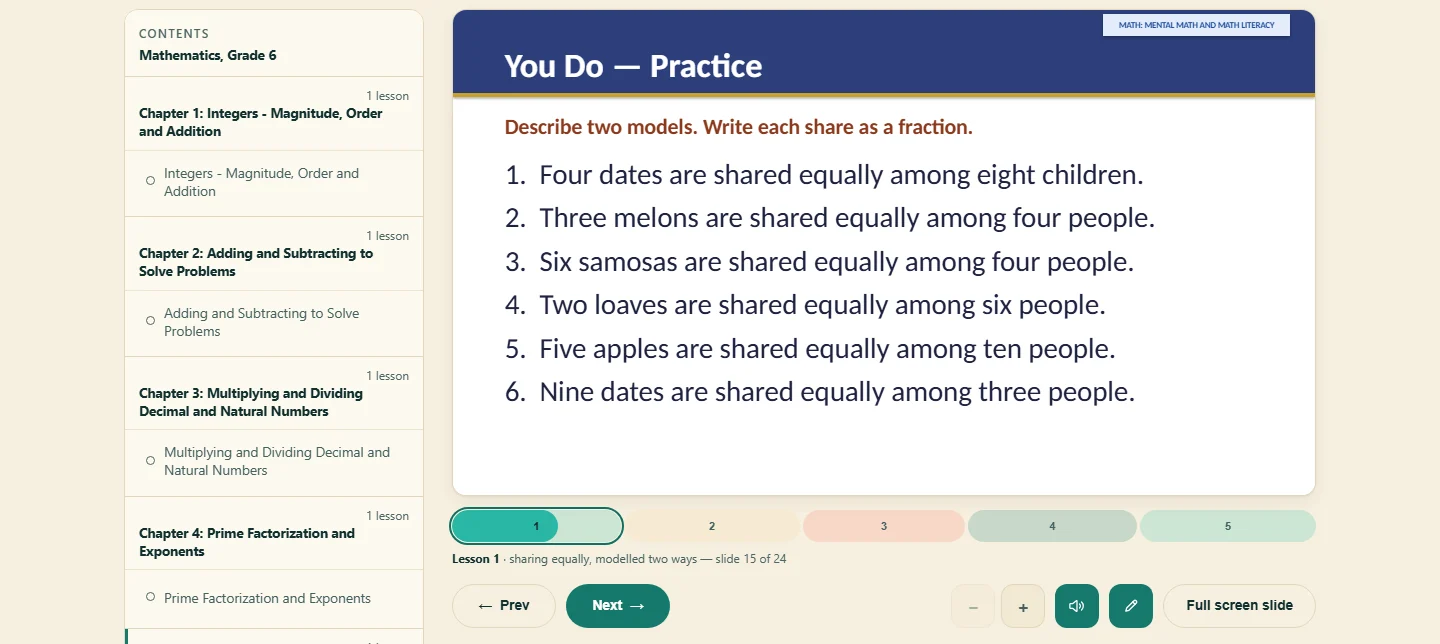
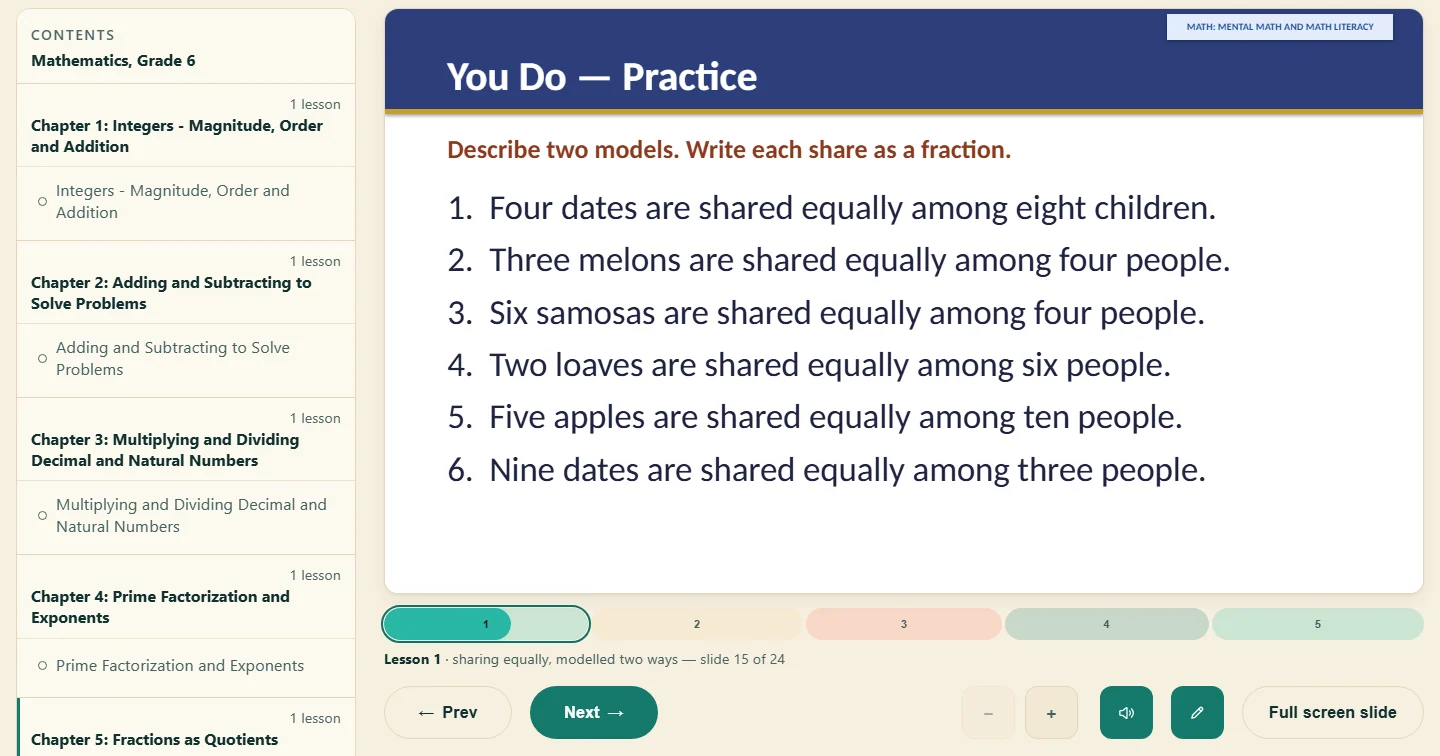
The course opens in our browser-based learning app. These views show a Grade 6 Mathematics example; this course’s own lessons are listed on this page.
A preview
A real slide from Scientific Explanations and Hypotheses. The full deck opens when you enrol. Every slide is watermarked to the account viewing it.
What is inside
Chapter 1: Scientific Explanations and Hypotheses
- Lesson 1What Makes an Explanation Scientific
- Lesson 2What a Hypothesis Is
- Lesson 3HANDS-ON LAB
- Lesson 4Evidence That Supports or Contradicts
- Lesson 5Objectivity and Accuracy
- Lesson 6HANDS-ON LAB
- Lesson 7Explaining Natural Phenomena
- Lesson 8HANDS-ON LAB
- Lesson 9Communicating for an Audience
- Lesson 10Graphs and Tables That Communicate
- Lesson 11Judging a Source
- Lesson 12Science Corrects Itself
- Lesson 13HANDS-ON LAB
- Lesson 14HANDS-ON LAB
Chapter 2: Heating, Cooling and the Particle Model
- Lesson 1Recalling the Particle Model
- Lesson 2Temperature and Particle Movement
- Lesson 3HANDS-ON LAB
- Lesson 4Heating: Particles Move Faster
- Lesson 5Cooling: Particles Slow Down
- Lesson 6HANDS-ON LAB
- Lesson 7Naming the Phase Changes
- Lesson 8HANDS-ON LAB
- Lesson 9Explaining Melting with the Particle Model
- Lesson 10Explaining Freezing with the Particle Model
- Lesson 11HANDS-ON LAB
- Lesson 12Explaining Evaporation and Condensation
- Lesson 13Volume Changes, Mass Does Not
- Lesson 14HANDS-ON LAB
Chapter 3: Temperature, Expansion and Water's Surprise
- Lesson 1How a Liquid Thermometer Works
- Lesson 2The Celsius Scale and Its Fixed Points
- Lesson 3HANDS-ON LAB
- Lesson 4Measuring Temperature Safely
- Lesson 5Expansion: What Heating Does to Size
- Lesson 6HANDS-ON LAB
- Lesson 7Contraction: What Cooling Does to Size
- Lesson 8Designing for Expansion and Contraction
- Lesson 9HANDS-ON LAB
- Lesson 10Water's Unusual Property
- Lesson 11The Ice Sheet That Protects a Lake
- Lesson 12HANDS-ON LAB
Chapter 4: Forces in Interactions
- Lesson 1What a Force Does in an Interaction
- Lesson 2Forces That Act from Outside
- Lesson 3HANDS-ON LAB
- Lesson 4Friction Opposes Movement
- Lesson 5Elastic and Spring Force
- Lesson 6HANDS-ON LAB
- Lesson 7Forces Inside an Object
- Lesson 8HANDS-ON LAB
- Lesson 9Compression: Squeezing and Squashing
- Lesson 10Shear: Pushing Opposite Ways
- Lesson 11HANDS-ON LAB
- Lesson 12How External Forces Cause Internal Forces
- Lesson 13Identifying Every Force in an Interaction
- Lesson 14HANDS-ON LAB
Chapter 5: Action, Reaction and Material Properties
- Lesson 1Temporary or Permanent Change of Shape
- Lesson 2Elasticity: Shape That Returns
- Lesson 3HANDS-ON LAB
- Lesson 4Plasticity: Shape That Stays
- Lesson 5HANDS-ON LAB
- Lesson 6Naming the Action Force
- Lesson 7Naming the Reaction Force
- Lesson 8HANDS-ON LAB
- Lesson 9Two Objects, Equal and Opposite
- Lesson 10HANDS-ON LAB
Chapter 6: Choosing and Managing Energy Resources
- Lesson 1Why One Energy Resource Is Chosen
- Lesson 2Availability and Accessibility
- Lesson 3HANDS-ON LAB
- Lesson 4Economic Impacts of Our Choices
- Lesson 5Societal Impacts of Our Choices
- Lesson 6HANDS-ON LAB
- Lesson 7Weighing All Four Factors Together
- Lesson 8Before Processing and After Processing
- Lesson 9HANDS-ON LAB
- Lesson 10Energy in Our Daily Lives
- Lesson 11Responsible Management of Resources
- Lesson 12HANDS-ON LAB
Chapter 7: Climate and the Systems That Shape It
- Lesson 1Weather and Climate Are Not the Same
- Lesson 2The Sun and a Habitable Climate
- Lesson 3HANDS-ON LAB
- Lesson 4Clouds That Reflect Sunlight into Space
- Lesson 5Ice That Reflects Light from the Sun
- Lesson 6HANDS-ON LAB
- Lesson 7The Three Effects Working Together
- Lesson 8HANDS-ON LAB
- Lesson 9Elevation, Water and Where You Live
- Lesson 10Natural Causes of Changes in Climate
- Lesson 11HANDS-ON LAB
- Lesson 12Where Climate Observations Come From
- Lesson 13Human Activities That Change the Climate
- Lesson 14HANDS-ON LAB
Chapter 8: Climate Change and Its Effects
- Lesson 1Effects on Land and Water
- Lesson 2Effects on Plants and Animals
- Lesson 3HANDS-ON LAB
- Lesson 4Effects on People
- Lesson 5Water Resources and Forest Fires
- Lesson 6HANDS-ON LAB
- Lesson 7Agriculture in a Changing Climate
- Lesson 8HANDS-ON LAB
- Lesson 9Extreme Weather Events on Earth
- Lesson 10Extreme Weather Events in Canada
- Lesson 11HANDS-ON LAB
- Lesson 12Technologies That Predict Extreme Weather
- Lesson 13Traditional Ways of Living Off the Land
- Lesson 14HANDS-ON LAB
Chapter 9: Ecosystems - Biotic and Abiotic
- Lesson 1What Makes an Ecosystem a System
- Lesson 2The Living Part of an Ecosystem
- Lesson 3HANDS-ON LAB
- Lesson 4The Non-Living Part of an Ecosystem
- Lesson 5HANDS-ON LAB
- Lesson 6Everything Influences Everything Else
- Lesson 7Many Kinds of Ecosystem
- Lesson 8HANDS-ON LAB
- Lesson 9Ecosystems That Store Greenhouse Gases
- Lesson 10HANDS-ON LAB
Chapter 10: Photosynthesis and Plants in Ecosystems
- Lesson 1What Photosynthesis Is
- Lesson 2The Inputs and the Outputs
- Lesson 3HANDS-ON LAB
- Lesson 4Chlorophyll: Collecting the Light
- Lesson 5How We Know Photosynthesis Has Happened
- Lesson 6HANDS-ON LAB
- Lesson 7Sugar Stored as Starch
- Lesson 8The Roles Plants Play in an Ecosystem
- Lesson 9HANDS-ON LAB
- Lesson 10Plants and Animals Need Each Other
- Lesson 11Plants Sacred to First Nations and Métis
- Lesson 12HANDS-ON LAB
Chapter 11: Exploring the Solar System
- Lesson 1Earth Is Part of the Solar System
- Lesson 2Naming and Ordering the Planets
- Lesson 3HANDS-ON LAB
- Lesson 4The Asteroid Belt
- Lesson 5Classifying Celestial Bodies
- Lesson 6HANDS-ON LAB
- Lesson 7How Celestial Bodies Differ
- Lesson 8HANDS-ON LAB
- Lesson 9Modelling the Solar System to Scale
- Lesson 10The Reclassification of Pluto
- Lesson 11HANDS-ON LAB
- Lesson 12Technologies That Explore Space
- Lesson 13Natural and Artificial Satellites
- Lesson 14HANDS-ON LAB
Chapter 12: Abstraction, Coding and Impacts
- Lesson 1What an Abstraction Is
- Lesson 2Abstractions in Daily Life
- Lesson 3HANDS-ON LAB
- Lesson 4Loops and the Three Structures
- Lesson 5Abstraction in the Design Process
- Lesson 6HANDS-ON LAB
- Lesson 7Intentional and Unintentional Impacts
- Lesson 8HANDS-ON LAB
Before you enrol
How do I get access?
Courses are licensed to schools and home-school programs — by grade, by subject, or the whole catalogue. Teachers and students enrol through their institution’s licence, and anyone can read a course page and its sample slides without one. If your school or home-school program is not on RISE yet, request a proposal. No card is collected anywhere. Inside a course nothing is timed: enrolment keeps one progress pointer on your account, so a course paused in November picks up exactly where it stopped.
Is there a record of completion?
Your account keeps a per-chapter record of what you have completed, which you can see any time in the portal. These courses are self-directed study; they do not carry accreditation, credit, or institutional approval.
Can I show the slides to my class?
Yes — projecting the decks to your own class from your own account is exactly what they are for. Every slide is watermarked to the account viewing it, so share your screen, not exported copies.
Will it work on a school network?
The portal is an ordinary website over standard HTTPS — no downloads, no plugins, no video CDN. If your school filter blocks it, ask IT to allow resourcesforislamicschools.com; the preview on this page is a quick way to test.
Ready to teach from it?
Opened through your institution’s licence. Nothing inside a course is timed.