Science, Grade 5
Aligned to the Alberta Program of Studies
12 chapters, about 149 slides each. Nothing inside a course is timed — a chapter paused in November picks up where it stopped.
Opened through your school or home-school program’s licence. Sign in with the address it gave you; the course opens in our learning portal.
What you get
1787 lesson-plan slides across 12 chapters, with the teaching script on the slides themselves. No files to download. Everything runs in the browser.
How to use it
Read a chapter through before the lesson, then project it. The teaching script is printed on the slides rather than hidden in speaker notes, so review a deck before it goes on the classroom screen. At home, the same decks read as guided lessons — a parent presents, or an older learner reads straight through. Your place is saved on every device.
Who it's by
Designed by Dr. Shameeza Khan, Ed.D. — University of Portland (Ed.D.).
Twelve chapters of Grade 5 Science, each a deck of eight to fourteen lessons with I Do, We Do and You Do stages, hands-on labs, and a chapter assessment with a marking guide. Written for the classroom teacher, with the teaching script on the slides.
Inside RISE Learn
The course opens in our browser-based learning app. These views show a Grade 6 Mathematics example; this course’s own lessons are listed on this page.
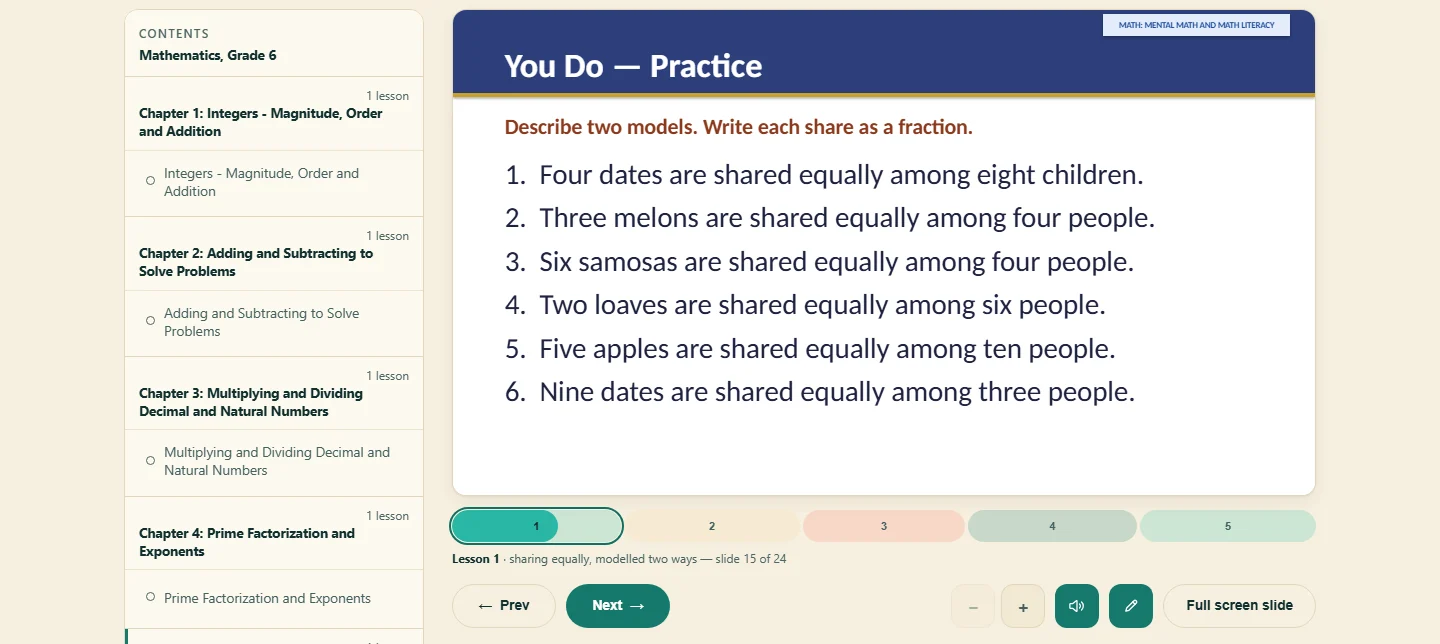
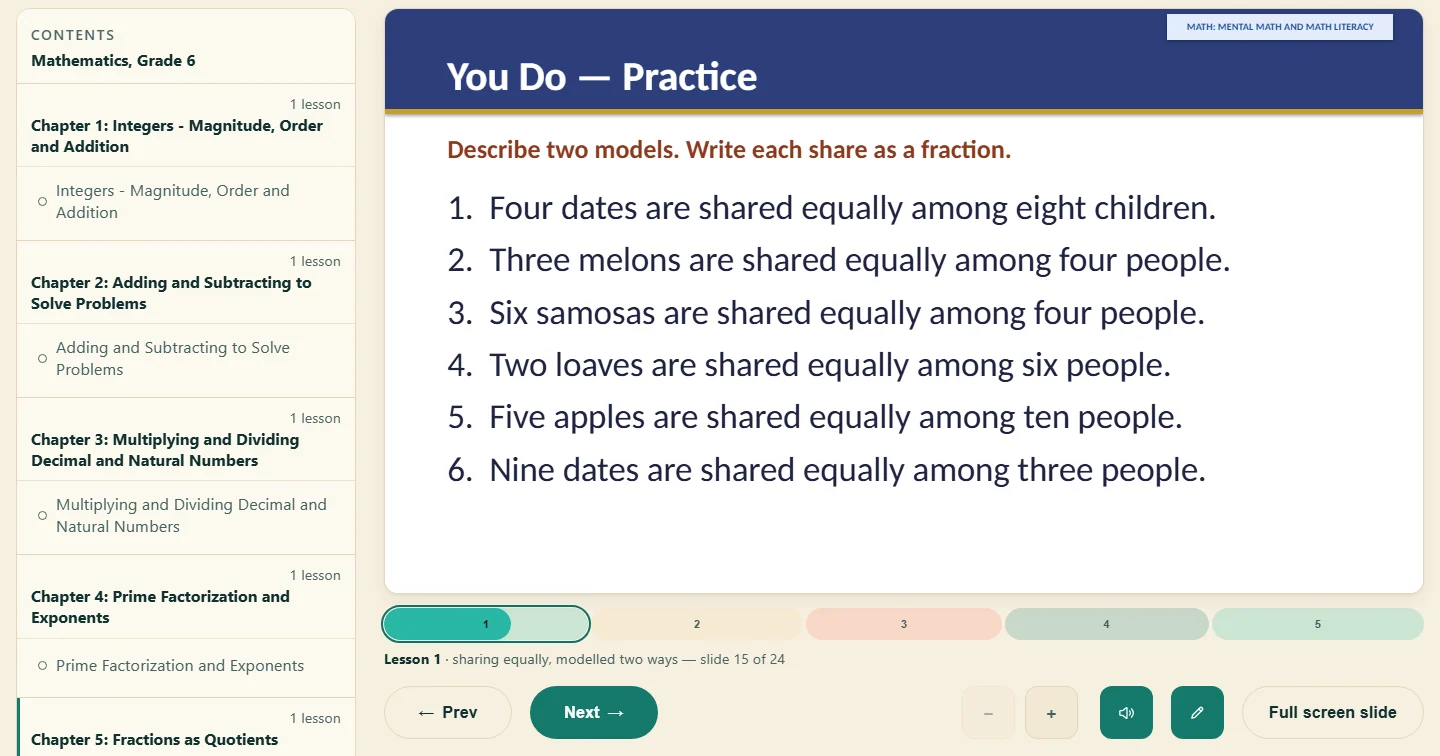
A preview
A real slide from Evidence, Variables and Ethics. The full deck opens when you enrol. Every slide is watermarked to the account viewing it.
What is inside
Chapter 1: Evidence, Variables and Ethics
- Lesson 1Why Honesty Comes First in Science
- Lesson 2Phenomena We Can and Cannot See
- Lesson 3What a Variable Is
- Lesson 4The Three Kinds of Variable
- Lesson 5HANDS-ON LAB
- Lesson 6What Bias Is
- Lesson 7HANDS-ON LAB
- Lesson 8Repeating and Reliability
- Lesson 9HANDS-ON LAB
- Lesson 10Showing Evidence Clearly
- Lesson 11When Evidence Is Communicated Badly
- Lesson 12HANDS-ON LAB
- Lesson 13Defending a Conclusion
- Lesson 14HANDS-ON LAB
Chapter 2: The Particle Model of Matter
- Lesson 1Why Scientists Use Models
- Lesson 2The Three Ideas of the Particle Model
- Lesson 3HANDS-ON LAB
- Lesson 4Particles in a Solid
- Lesson 5Particles in a Liquid
- Lesson 6HANDS-ON LAB
- Lesson 7Particles in a Gas
- Lesson 8Drawing the Three States
- Lesson 9HANDS-ON LAB
- Lesson 10Attractive Forces Between Particles
- Lesson 11Shape, Flow and Filling a Container
- Lesson 12HANDS-ON LAB
Chapter 3: Mass, Volume and Density
- Lesson 1The Physical Properties of Matter
- Lesson 2Mass: The Amount of Matter
- Lesson 3HANDS-ON LAB
- Lesson 4Grams, Kilograms and SI Units
- Lesson 5Volume: The Space Matter Takes Up
- Lesson 6HANDS-ON LAB
- Lesson 7Finding the Volume of a Solid
- Lesson 8HANDS-ON LAB
- Lesson 9Density: Mass Compared with Volume
- Lesson 10Density and the Particle Model
- Lesson 11HANDS-ON LAB
- Lesson 12Floating, Sinking and Layers
- Lesson 13Compressibility: Air and Water
- Lesson 14HANDS-ON LAB
Chapter 4: Forces in Air - Flight
- Lesson 1The Four Forces of Flight
- Lesson 2Weight: A Force Caused by Gravity
- Lesson 3HANDS-ON LAB
- Lesson 4Lift: The Force That Holds Things Up
- Lesson 5Thrust: The Force That Pushes Forward
- Lesson 6HANDS-ON LAB
- Lesson 7Drag: The Force That Slows Things Down
- Lesson 8HANDS-ON LAB
- Lesson 9Two Pairs of Opposing Forces
- Lesson 10Speed, Altitude and Level Flight
- Lesson 11HANDS-ON LAB
- Lesson 12Watching Birds and Seeds in Flight
- Lesson 13Traditional Technologies and Flight
- Lesson 14HANDS-ON LAB
Chapter 5: Forces in Water - Floating and Sinking
- Lesson 1Fluids Are Liquids and Gases
- Lesson 2The Buoyant Force
- Lesson 3HANDS-ON LAB
- Lesson 4Weight Down, Buoyant Force Up
- Lesson 5When the Buoyant Force Is Smaller
- Lesson 6HANDS-ON LAB
- Lesson 7Density and What Floats
- Lesson 8Floating in Different Fluids
- Lesson 9HANDS-ON LAB
- Lesson 10Forces in Water and Forces in Air
- Lesson 11Designing a Floating Device
- Lesson 12HANDS-ON LAB
Chapter 6: Energy Resources
- Lesson 1What an Energy Resource Is
- Lesson 2Renewable and Non-Renewable
- Lesson 3HANDS-ON LAB
- Lesson 4Energy from the Wind
- Lesson 5Energy from Water and Hydro
- Lesson 6HANDS-ON LAB
- Lesson 7Biomass, Geothermal and Tidal
- Lesson 8Fossil Fuels and Nuclear
- Lesson 9HANDS-ON LAB
- Lesson 10Advantages and Disadvantages
- Lesson 11How Canada Meets Its Energy Needs
- Lesson 12HANDS-ON LAB
Chapter 7: Weather and Climate
- Lesson 1Weather Is What Today Is Like
- Lesson 2The Six Things We Measure
- Lesson 3HANDS-ON LAB
- Lesson 4Climate: Thirty Years of Weather
- Lesson 5Weather or Climate?
- Lesson 6HANDS-ON LAB
- Lesson 7Tools That Measure the Wind
- Lesson 8HANDS-ON LAB
- Lesson 9Air Pressure and Humidity
- Lesson 10Showing Weather Data Clearly
- Lesson 11HANDS-ON LAB
- Lesson 12What Shapes a Climate
- Lesson 13The Five Climate Zones
- Lesson 14HANDS-ON LAB
Chapter 8: Climate, Agriculture and Living Things
- Lesson 1Climate Shapes How We Live
- Lesson 2Climate Shapes Animal Activity
- Lesson 3HANDS-ON LAB
- Lesson 4Climate, Crop Type and Crop Production
- Lesson 5Weather Events That Farmers Respond To
- Lesson 6HANDS-ON LAB
- Lesson 7Soil Quality and Water Access
- Lesson 8What Conservation Agriculture Means
- Lesson 9HANDS-ON LAB
- Lesson 10Sustainable Harvesting
- Lesson 11Reading the Seasons Where We Live
- Lesson 12HANDS-ON LAB
Chapter 9: Body Systems That Keep Us Alive
- Lesson 1The Work of Staying Alive
- Lesson 2What a Body System Is
- Lesson 3HANDS-ON LAB
- Lesson 4Inside the Digestive System
- Lesson 5What Digestion Does to Food
- Lesson 6HANDS-ON LAB
- Lesson 7Inside the Respiratory System
- Lesson 8HANDS-ON LAB
- Lesson 9The Gases We Exchange
- Lesson 10Inside the Circulatory System
- Lesson 11HANDS-ON LAB
- Lesson 12Muscles and Bones Working Together
- Lesson 13Three Systems, One Delivery
- Lesson 14HANDS-ON LAB
Chapter 10: Transport Systems in Plants
- Lesson 1Plants Are Living Systems Too
- Lesson 2Why a Plant Must Move Things Around
- Lesson 3HANDS-ON LAB
- Lesson 4Xylem: The Way Up from the Roots
- Lesson 5Phloem: Sugars Leaving the Leaves
- Lesson 6HANDS-ON LAB
- Lesson 7Xylem, Phloem and the Circulatory System
- Lesson 8HANDS-ON LAB
Chapter 11: Astronomical Phenomena
- Lesson 1Cycles We Can See in the Sky
- Lesson 2The Tilt of the Earth
- Lesson 3HANDS-ON LAB
- Lesson 4Longer Days and Shorter Days
- Lesson 5Equinoxes and Solstices
- Lesson 6HANDS-ON LAB
- Lesson 7The Midnight Sun and the Polar Night
- Lesson 8HANDS-ON LAB
- Lesson 9Lunar Eclipses
- Lesson 10Solar Eclipses and Eye Safety
- Lesson 11HANDS-ON LAB
- Lesson 12Auroras and the Northern Lights
- Lesson 13Cycles, Calendars and Ways of Showing Them
- Lesson 14HANDS-ON LAB
Chapter 12: Designing With Code
- Lesson 1What a Computational Artifact Is
- Lesson 2Algorithms and a Machine That Cannot Think
- Lesson 3HANDS-ON LAB
- Lesson 4Loops: Saying It Once, Not Ten Times
- Lesson 5Six Things That Shape a Design
- Lesson 6HANDS-ON LAB
- Lesson 7Enhancing, Refining and Designing Together
- Lesson 8HANDS-ON LAB
Before you enrol
How do I get access?
Courses are licensed to schools and home-school programs — by grade, by subject, or the whole catalogue. Teachers and students enrol through their institution’s licence, and anyone can read a course page and its sample slides without one. If your school or home-school program is not on RISE yet, request a proposal. No card is collected anywhere. Inside a course nothing is timed: enrolment keeps one progress pointer on your account, so a course paused in November picks up exactly where it stopped.
Is there a record of completion?
Your account keeps a per-chapter record of what you have completed, which you can see any time in the portal. These courses are self-directed study; they do not carry accreditation, credit, or institutional approval.
Can I show the slides to my class?
Yes — projecting the decks to your own class from your own account is exactly what they are for. Every slide is watermarked to the account viewing it, so share your screen, not exported copies.
Will it work on a school network?
The portal is an ordinary website over standard HTTPS — no downloads, no plugins, no video CDN. If your school filter blocks it, ask IT to allow resourcesforislamicschools.com; the preview on this page is a quick way to test.
Ready to teach from it?
Opened through your institution’s licence. Nothing inside a course is timed.