Reading and Writing with Purpose 2
A journey inspired by stories of hope from the Qur'an
9 chapters, about 90 slides each. Nothing inside a course is timed — a chapter paused in November picks up where it stopped.
Opened through your school or home-school program’s licence. Sign in with the address it gave you; the course opens in our learning portal.
What you get
807 lesson-plan slides across 9 chapters, with the teaching script on the slides themselves. No files to download. Everything runs in the browser.
How to use it
Read a chapter through before the lesson, then project it. The teaching script is printed on the slides rather than hidden in speaker notes, so review a deck before it goes on the classroom screen. At home, the same decks read as guided lessons — a parent presents, or an older learner reads straight through. Your place is saved on every device.
Who it's by
Written by Dr. Shameeza Khan, Ed.D. — University of Portland (Ed.D.).
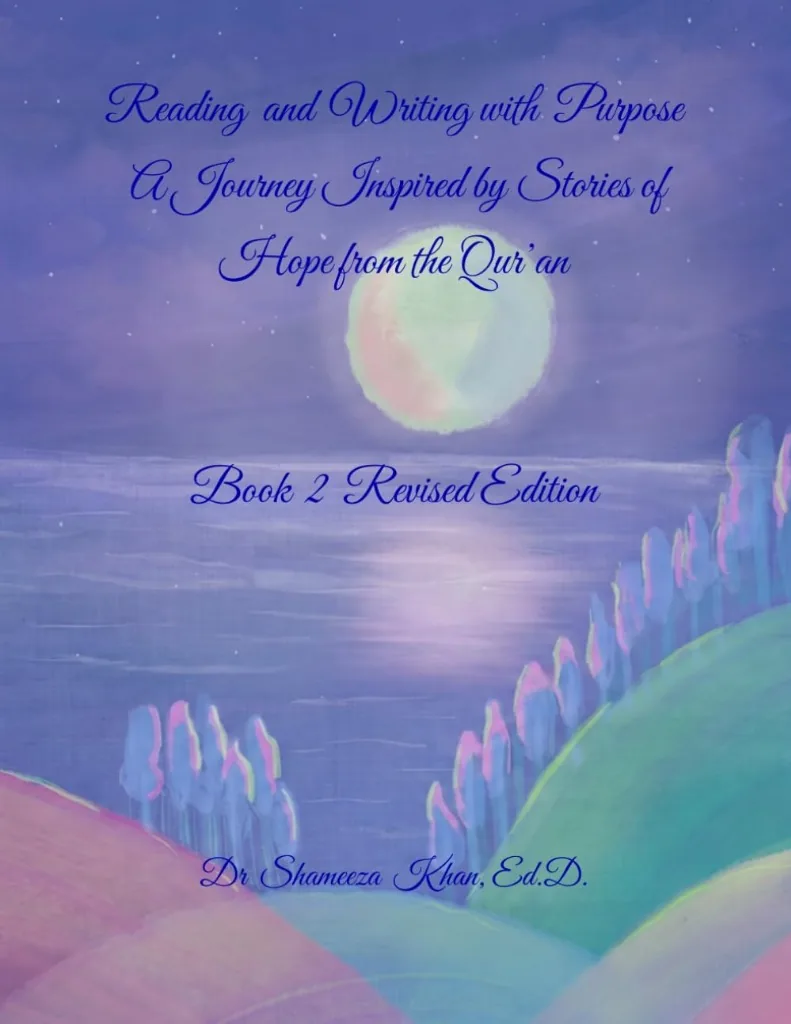
The educator edition of Reading and Writing with Purpose 2, for teachers delivering the book in a classroom.
Each chapter carries its learning outcomes and a presenter deck to teach from.
Designed to be worked through alongside the printed student book.
Inside RISE Learn
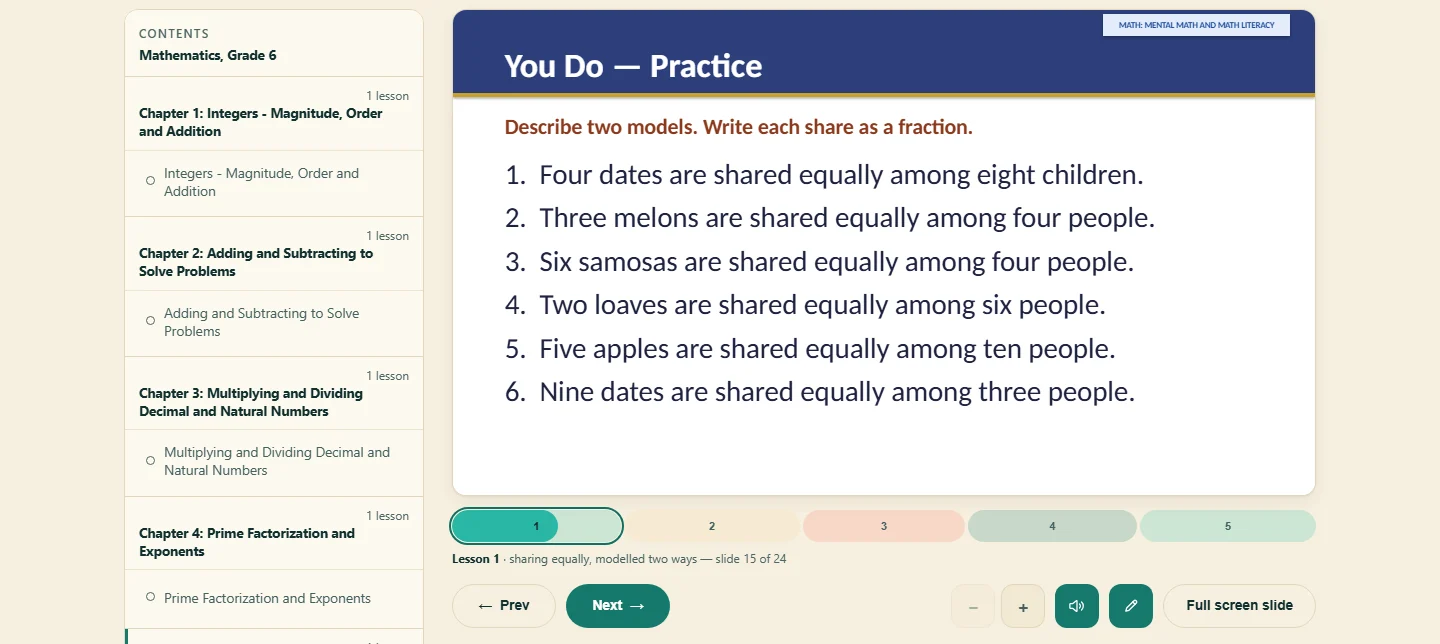
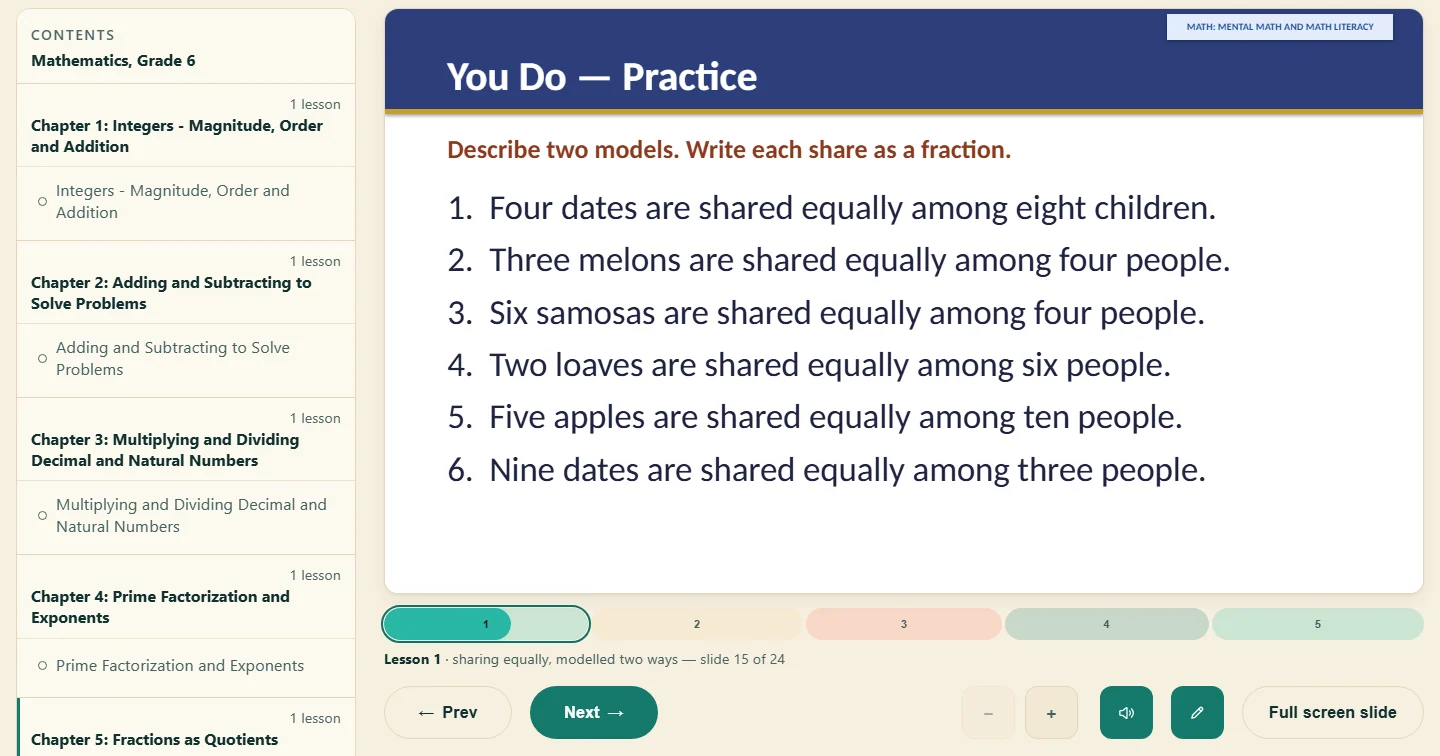
The course opens in our browser-based learning app. These views show a Grade 6 Mathematics example; this course’s own lessons are listed on this page.
A preview
A real slide from Narrative and Expository Writing Section. The full deck opens when you enrol. Every slide is watermarked to the account viewing it.
What is inside
Narrative and Expository Writing Section
- Lesson 1Reading · Welcome to Grade 5 Reading
- Lesson 2Writing · Our Writing Journey
- Lesson 3Writing · Planning My Story
- Lesson 4Reading · Literary Elements
- Lesson 5Writing · Drafting My Story: Study the Model and Write Together
- Lesson 6Writing · Drafting My Story: Write and Illustrate My Memory
- Lesson 7Reading · Reading Comprehension Strategies
- Lesson 8Writing · Revising and Sharing My Story: Check and Revise
- Lesson 9Writing · Revising and Sharing My Story: Read and Give Feedback
- Lesson 10Reading · Novel Study: Launching Our Class Novel — Predict and Read
- Lesson 11Reading · Novel Study: Launching Our Class Novel — Summarise and Respond
- Lesson 12Writing · Literary Elements in My Writing: Plan and Practise Dialogue
- Lesson 13Writing · Literary Elements in My Writing: Write the Climax
Chapter 1: Understanding Theme
- Lesson 1Reading · Themes and Expository Essays
- Lesson 2Writing · The Rubric and Planning
- Lesson 3Reading · Making Connections
- Lesson 4Reading · The Story of Prophet Adam (A.S.)
- Lesson 5Writing · Sentence Starters and Words that Wow
- Lesson 6Reading · Themes in the Story of Prophet Adam (A.S.)
- Lesson 7Writing · Writing a First Draft
- Lesson 8Reading · The Story of Prophet Idris (A.S.)
- Lesson 9Writing · Feedback and Sharing Our Writing
- Lesson 10Reading · Comparing Themes
- Lesson 11Reading · Novel Study: The Theme of Our Class Novel
Chapter 2: Planning the Plot
- Lesson 1Writing · Summative Writing Task: Staying Steadfast
- Lesson 2Reading · What Is a Plot?
- Lesson 3Writing · The Rubric and Planning My Narrative
- Lesson 4Reading · The Story of Prophet Hud (A.S.)
- Lesson 5Reading · Analysing Plot Structure
- Lesson 6Writing · Dynamic Sentence Starters
- Lesson 7Reading · Narrative Text Structure
- Lesson 8Writing · Words that Wow and Dialogue
- Lesson 9Reading · Novel Study: The Plot of Our Novel
- Lesson 10Writing · Writing the First Draft
- Lesson 11Reading · The Story of Prophet Ismail (A.S.)
- Lesson 12Writing · Feedback and the Author's Chair
- Lesson 13Reading · Summarising and Comparing Plots
Chapter 3: Choosing Characters
- Lesson 1Reading · Meet the Characters
- Lesson 2Writing · Our Writing Goal
- Lesson 3Reading · How Writers Show Character
- Lesson 4Writing · Planning a Character-Driven Story
- Lesson 5Reading · The Story of Prophet Nuh (A.S.)
- Lesson 6Writing · Dynamic Sentence Starters
- Lesson 7Reading · Characterisation in the Story of Nuh (A.S.)
- Lesson 8Writing · Show, Don't Tell
- Lesson 9Reading · Novel Study: Characters in Our Novel
- Lesson 10Writing · Summative Writing Task: Gratitude or Greed
- Lesson 11Writing · Dialogue and Speaking in Role
- Lesson 12Writing · Drafting Our Story
- Lesson 13Reading · The Story of Prophet Lut (A.S.)
- Lesson 14Writing · Feedback and the Author's Chair
- Lesson 15Reading · Comparing Two Prophets' Stories
Chapter 4: Selecting Settings
- Lesson 1Reading · What Is Setting?
- Lesson 2Writing · The Narrative Rubric and the Five Senses
- Lesson 3Reading · The Story of Prophet Salih (A.S.)
- Lesson 4Writing · Planning a Story with a Strong Setting
- Lesson 5Reading · Discussing Setting in the Story
- Lesson 6Writing · Dynamic Sentence Starters
- Lesson 7Reading · Novel Study: Setting and Mood
- Lesson 8Writing · Words that Wow: Describing Settings
- Lesson 9Reading · The Story of Prophet Shu'aib (A.S.)
- Lesson 10Writing · Drafting My Story
- Lesson 11Reading · Synthesising and Comparing Settings
- Lesson 12Writing · Feedback and the Author's Chair
Chapter 5: Considering Conflicts
- Lesson 1Reading · What Is a Conflict?
- Lesson 2Writing · How Our Story Will Be Assessed
- Lesson 3Reading · Summarising Key Ideas
- Lesson 4Writing · Planning a Conflict Story
- Lesson 5Writing · Planning a Conflict Story: Build the Plot Plan
- Lesson 6Reading · The Story of Prophet Ibrahim (A.S.): Complete First Reading
- Lesson 7Reading · The Story of Prophet Ibrahim (A.S.): Close Reading for Conflict
- Lesson 8Writing · Dynamic Sentence Starters
- Lesson 9Reading · Analysing the Conflicts
- Lesson 10Writing · Words that Wow and Paragraphs
- Lesson 11Writing · Speaking: A Class Debate
- Lesson 12Reading · Novel Study: The Main Conflict
- Lesson 13Writing · Model and Share a Conflict Story
- Lesson 14Writing · Draft the Complete Conflict Story
- Lesson 15Reading · The Story of Prophet Ya'qub (A.S.): Complete Account
- Lesson 16Reading · The Story of Prophet Ya'qub (A.S.): Judge the Response
- Lesson 17Writing · Feedback and the Author's Chair
- Lesson 18Reading · Sharing Our Understanding
- Lesson 19Writing · Summative Writing Task: Solving a Conflict with Good Character
Chapter 6: Revealing Resolutions
- Lesson 1Reading · What Is a Resolution?
- Lesson 2Writing · Planning a Redemption Story
- Lesson 3Reading · The Story of Prophet Yunus (A.S.)
- Lesson 4Writing · Satisfying Endings
- Lesson 5Reading · Resolutions in the Story
- Lesson 6Writing · Drafting My Story
- Lesson 7Reading · Novel Study: How Will It End?
- Lesson 8Reading · The Story of Prophet Dawud (A.S.)
- Lesson 9Writing · Feedback and Author's Chair
- Lesson 10Reading · Comparing Resolutions
Poetry, Novels and My Ramadan Goal
- Lesson 1Reading · Introduction to Poetry
- Lesson 2Reading · Wudu: Read the Poem and Trace Its Sequence
- Lesson 3Reading · Wudu: Test the Analysis Against the Poem
- Lesson 4Reading · SALAH: Read the Speaker’s Words
- Lesson 5Reading · SALAH: Check the Sound Analysis
- Lesson 6Writing · Writing an Acrostic Poem
- Lesson 7Reading · Good Manners: Read the Voice and Message
- Lesson 8Reading · Good Manners: Explain the Free Verse
- Lesson 9Writing · Writing a Free Verse Poem
- Lesson 10Reading · Peaceful Heart: Read Words and Shape
- Lesson 11Reading · Peaceful Heart: Test the Shape Analysis
- Lesson 12Writing · Writing a Concrete Poem
- Lesson 13Reading · Comparing and Evaluating Poems
- Lesson 14Writing · Poetry Recital
- Lesson 15Reading · Novel Study: Theme, Setting and Characters
- Lesson 16Reading · Novel Study: Plot Through an Islamic Lens
- Lesson 17Writing · Reading a Model Essay: My Ramadan Goal
- Lesson 18Writing · Planning My Ramadan Goal Essay
- Lesson 19Writing · Drafting My Ramadan Goal Essay
- Lesson 20Writing · Revising and Presenting My Goal
- Lesson 21Writing · Carry the Poetry and Goal Tools Forward
Reflection Writing and Continuing the Journey
- Lesson 1Reading · Reading a Model Reflection
- Lesson 2Writing · Listening Actively to the Khutbah
- Lesson 3Reading · Reading Reflection Prompts Critically
- Lesson 4Writing · The Shape of a Reflection
- Lesson 5Writing · Planning with Words that Resonate
- Lesson 6Reading · Novel Study: The Novel That Changed My Thinking
- Lesson 7Writing · Writing My Reflection
- Lesson 8Reading · Continuing the Journey: Check the Year’s Claim
- Lesson 9Reading · References: Check Identity and Evidence
Before you enrol
How do I get access?
Courses are licensed to schools and home-school programs — by grade, by subject, or the whole catalogue. Teachers and students enrol through their institution’s licence, and anyone can read a course page and its sample slides without one. If your school or home-school program is not on RISE yet, request a proposal. No card is collected anywhere. Inside a course nothing is timed: enrolment keeps one progress pointer on your account, so a course paused in November picks up exactly where it stopped.
Is there a record of completion?
Your account keeps a per-chapter record of what you have completed, which you can see any time in the portal. These courses are self-directed study; they do not carry accreditation, credit, or institutional approval.
Can I show the slides to my class?
Yes — projecting the decks to your own class from your own account is exactly what they are for. Every slide is watermarked to the account viewing it, so share your screen, not exported copies.
Will it work on a school network?
The portal is an ordinary website over standard HTTPS — no downloads, no plugins, no video CDN. If your school filter blocks it, ask IT to allow resourcesforislamicschools.com; the preview on this page is a quick way to test.
Ready to teach from it?
Opened through your institution’s licence. Nothing inside a course is timed.