Mathematics, Grade 6
Aligned to the Alberta Program of Studies
15 chapters, about 169 slides each. Nothing inside a course is timed — a chapter paused in November picks up where it stopped.
Opened through your school or home-school program’s licence. Sign in with the address it gave you; the course opens in our learning portal.
What you get
2540 lesson-plan slides across 15 chapters, with the teaching script on the slides themselves. No files to download. Everything runs in the browser.
How to use it
Read a chapter through before the lesson, then project it. The teaching script is printed on the slides rather than hidden in speaker notes, so review a deck before it goes on the classroom screen. At home, the same decks read as guided lessons — a parent presents, or an older learner reads straight through. Your place is saved on every device.
Who it's by
Designed by Dr. Shameeza Khan, Ed.D. — University of Portland (Ed.D.).
Fifteen chapters of Grade 6 Mathematics, from integers and the number line through fractions, ratios and algebra to the Cartesian plane, volume and relative frequency. Each chapter is a deck of six to seven lessons with I Do, We Do and You Do stages, and two chapter assessments -- one for mental math and math literacy, one for problem solving.
Inside RISE Learn
The course opens in our browser-based learning app. These views show a Grade 6 Mathematics example; this course’s own lessons are listed on this page.
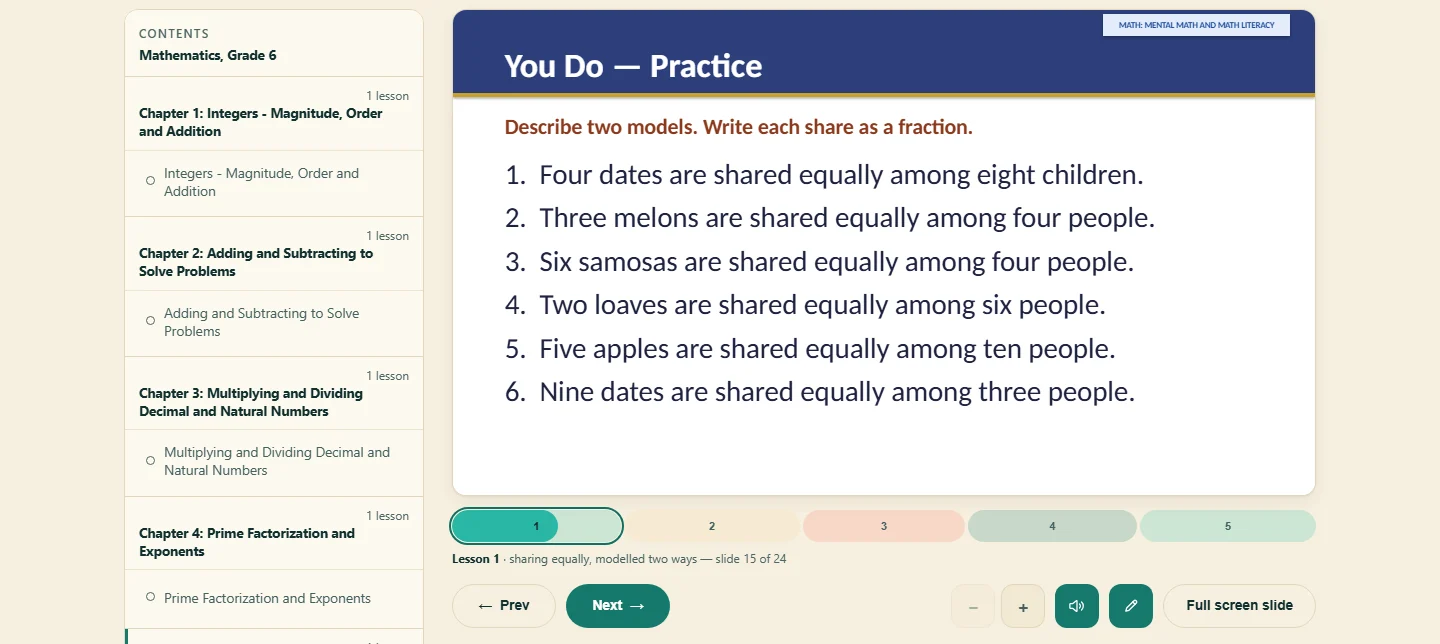
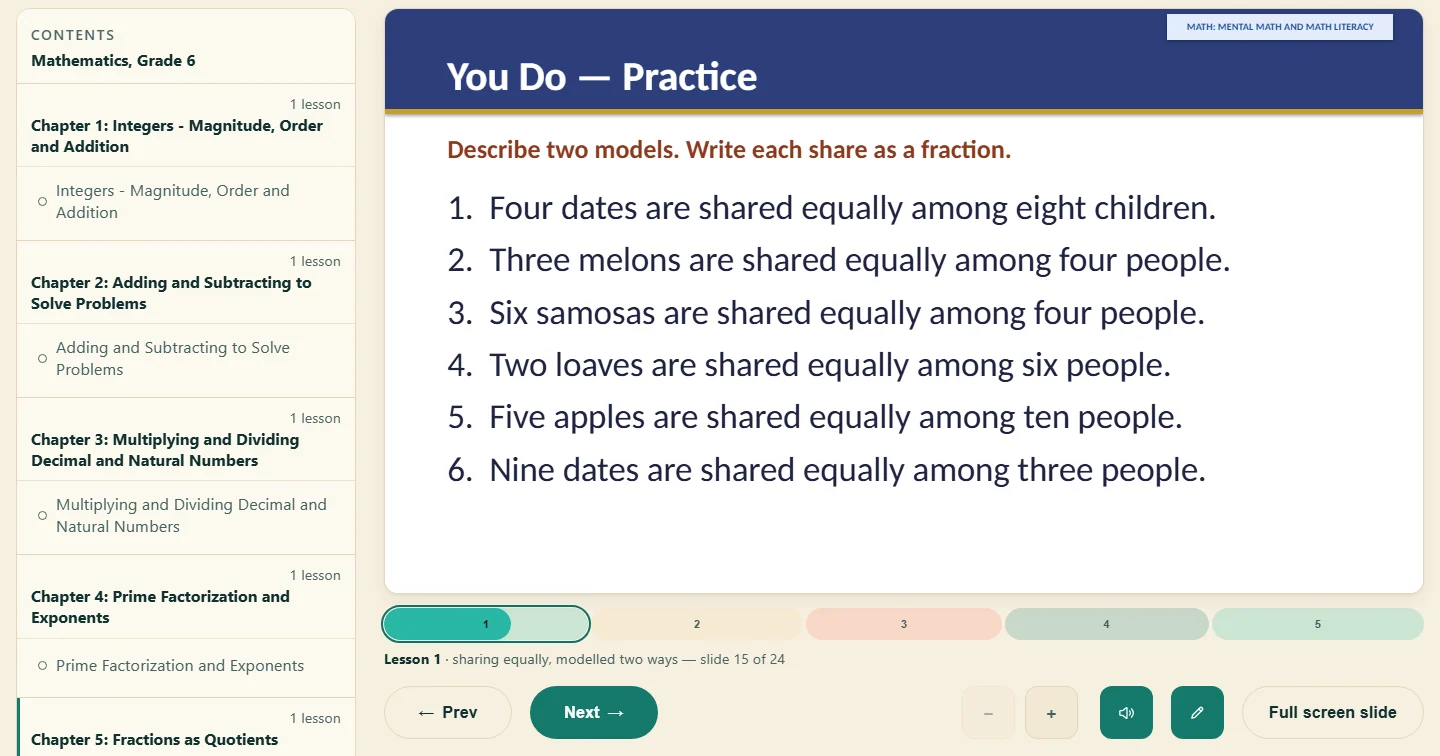
A preview
A real slide from Integers - Magnitude, Order and Addition. The full deck opens when you enrol. Every slide is watermarked to the account viewing it.
What is inside
Chapter 1: Integers - Magnitude, Order and Addition
- Lesson 1Numbers Below Zero
- Lesson 2Magnitude: Distance from Zero
- Lesson 3Additive Inverses and the Sum That Makes Zero
- Lesson 4Horizontal and Vertical Number Lines
- Lesson 5Comparing and Ordering Integers
- Lesson 6Zero Pairs and Adding Integers
- Lesson 7Expressing a Difference as a Sum
Chapter 2: Adding and Subtracting to Solve Problems
- Lesson 1The Standard Algorithms, Reviewed
- Lesson 2Estimating to Check Reasonableness
- Lesson 3Problems with Money
- Lesson 4Problems with Metric Measurement
- Lesson 5Multi-Step Problems and Decisions
Chapter 3: Multiplying and Dividing Decimal and Natural Numbers
- Lesson 1The Standard Algorithm for Multiplication
- Lesson 2Multiplying Decimals by 2-Digit Natural Numbers
- Lesson 3The Standard Algorithm for Division
- Lesson 4Dividing Decimals by 2-Digit Natural Numbers
- Lesson 5Remainders as Decimals, and Choosing the Right Form
- Lesson 6Estimating to Judge a Product or a Quotient
- Lesson 7Solving Problems with Money
Chapter 4: Prime Factorization and Exponents
- Lesson 1Building a Product in More Than One Way
- Lesson 2Prime and Composite Numbers, and Factor Trees
- Lesson 3The Prime Factorization of a Composite Number
- Lesson 4Common Factors from Prime Factorizations
- Lesson 5Reading Divisibility from a Prime Factorization
- Lesson 6Powers: Base, Exponent and Value
- Lesson 7Powers Inside a Prime Factorization
Chapter 5: Fractions as Quotients
- Lesson 1Sharing Equally, Modelled Two Ways
- Lesson 2Describing an Equal Share with a Fraction
- Lesson 3A Fraction Is a Division Statement
- Lesson 4From Fraction to Decimal by Dividing
- Lesson 5Equivalent Fractions, One Quotient
Chapter 6: Adding and Subtracting Fractions with Denominators within 100
- Lesson 1Fractions with the Same Unit, and Regrouping to Subtract
- Lesson 2Related Denominators and the Factor That Relates Them
- Lesson 3Expressing Two Fractions with a Common Denominator
- Lesson 4The Product of the Denominators as a Common Denominator
- Lesson 5Adding and Subtracting Fractions with Unrelated Denominators
- Lesson 6Solving Multi-Step Problems with Fractions
Chapter 7: Multiplying Natural Numbers by Fractions
- Lesson 1Multiplication as Repeated Addition of a Fraction
- Lesson 2Multiply the Numerator, Keep the Denominator
- Lesson 3A Unit Fraction of a Number Is a Division
- Lesson 4Taking Part of a Quantity
- Lesson 5Multiplication Does Not Always Make a Number Larger
- Lesson 6Solving Problems with Fractions of Quantities
Chapter 8: Ratios, Rates and Percentages
- Lesson 1Equivalent Ratios
- Lesson 2Proportional Relationships and Proportions
- Lesson 3Finding a Missing Term with a Proportion
- Lesson 4Rates and Unit Rates
- Lesson 5Comparing Rates to Judge Better Value
- Lesson 6Percentage of a Number
- Lesson 7Solving Multi-Step Problems
Chapter 9: Expressions and Equations
- Lesson 1The Order of Operations
- Lesson 2Variables, Terms and Like Terms
- Lesson 3Simplifying by Combining Like Terms
- Lesson 4Algebraic Properties
- Lesson 5Solving One-Operation Equations
- Lesson 6Solving Two-Operation Equations
- Lesson 7Choosing a Strategy and Simplifying First
- Lesson 8Solving Problems with Equations
Chapter 10: Symmetry, Congruence and Tessellations
- Lesson 1Symmetry as a Relationship Between Two Shapes
- Lesson 2Naming the Symmetry: Reflection or Rotation
- Lesson 3Combining Two Transformations
- Lesson 4Congruence: Identical Size and Shape
- Lesson 5Tessellations: Tiling the Plane
- Lesson 6Tessellations in Objects, Art and Architecture
Chapter 11: The Cartesian Plane - Location and Movement
- Lesson 1Two Number Lines That Cross
- Lesson 2Locating and Describing Points
- Lesson 3Polygons and Their Vertices
- Lesson 4Translating a Polygon
- Lesson 5Reflecting a Polygon
- Lesson 6Rotating a Polygon About a Vertex
- Lesson 7Relating a Polygon and Its Image
Chapter 12: Area of Parallelograms and Triangles
- Lesson 1Parallelograms, Base and Height
- Lesson 2Cut and Slide: Area Is Base Times Height
- Lesson 3Finding a Missing Base or Height
- Lesson 4A Triangle Is Half a Parallelogram
- Lesson 5Triangles With the Same Base and Height
- Lesson 6Composite Shapes Cut More Than One Way
- Lesson 7Solving Problems About Area
Chapter 13: Volume of Right Rectangular Prisms
- Lesson 1Volume, Congruent Units and Cubic Units
- Lesson 2Building Prisms: Layers and Arrays
- Lesson 3Volume as an Area Moved Through a Height
- Lesson 4Volume by Multiplication and Choosing the Base
- Lesson 5Same Volume, Different Prisms
- Lesson 6Solving Problems with Volume
Chapter 14: Functions and Change
- Lesson 1Variables, and the Quantity That Follows
- Lesson 2Describing the Rule in Words
- Lesson 3Tables of Values and One Output for Each Input
- Lesson 4Plotting a Function in the First Quadrant
- Lesson 5Writing the Expression, and One Function in Many Forms
- Lesson 6Forwards and Backwards Through a Function
- Lesson 7Solving Problems with Functions
Chapter 15: Relative Frequency and Experimental Data
- Lesson 1From a Count to a Share
- Lesson 2Comparing Groups of Different Sizes
- Lesson 3Experiments, Outcomes and Events
- Lesson 4Predicting, Then Collecting the Data
- Lesson 5Describing Likelihood from Collected Data
- Lesson 6More Trials, Better Estimates
Before you enrol
How do I get access?
Courses are licensed to schools and home-school programs — by grade, by subject, or the whole catalogue. Teachers and students enrol through their institution’s licence, and anyone can read a course page and its sample slides without one. If your school or home-school program is not on RISE yet, request a proposal. No card is collected anywhere. Inside a course nothing is timed: enrolment keeps one progress pointer on your account, so a course paused in November picks up exactly where it stopped.
Is there a record of completion?
Your account keeps a per-chapter record of what you have completed, which you can see any time in the portal. These courses are self-directed study; they do not carry accreditation, credit, or institutional approval.
Can I show the slides to my class?
Yes — projecting the decks to your own class from your own account is exactly what they are for. Every slide is watermarked to the account viewing it, so share your screen, not exported copies.
Will it work on a school network?
The portal is an ordinary website over standard HTTPS — no downloads, no plugins, no video CDN. If your school filter blocks it, ask IT to allow resourcesforislamicschools.com; the preview on this page is a quick way to test.
Ready to teach from it?
Opened through your institution’s licence. Nothing inside a course is timed.