Mathematics, Grade 5
Aligned to the Alberta Program of Studies
13 chapters, about 157 slides each. Nothing inside a course is timed — a chapter paused in November picks up where it stopped.
Opened through your school or home-school program’s licence. Sign in with the address it gave you; the course opens in our learning portal.
What you get
2037 lesson-plan slides across 13 chapters, with the teaching script on the slides themselves. No files to download. Everything runs in the browser.
How to use it
Read a chapter through before the lesson, then project it. The teaching script is printed on the slides rather than hidden in speaker notes, so review a deck before it goes on the classroom screen. At home, the same decks read as guided lessons — a parent presents, or an older learner reads straight through. Your place is saved on every device.
Thirteen chapters of Grade 5 Mathematics, from patterns in place value through fractions, ratios and algebraic expressions to symmetry, area and the coordinate grid. Each chapter is a deck of six to eight lessons with I Do, We Do and You Do stages, and two chapter assessments -- one for mental math and math literacy, one for problem solving.
Inside RISE Learn
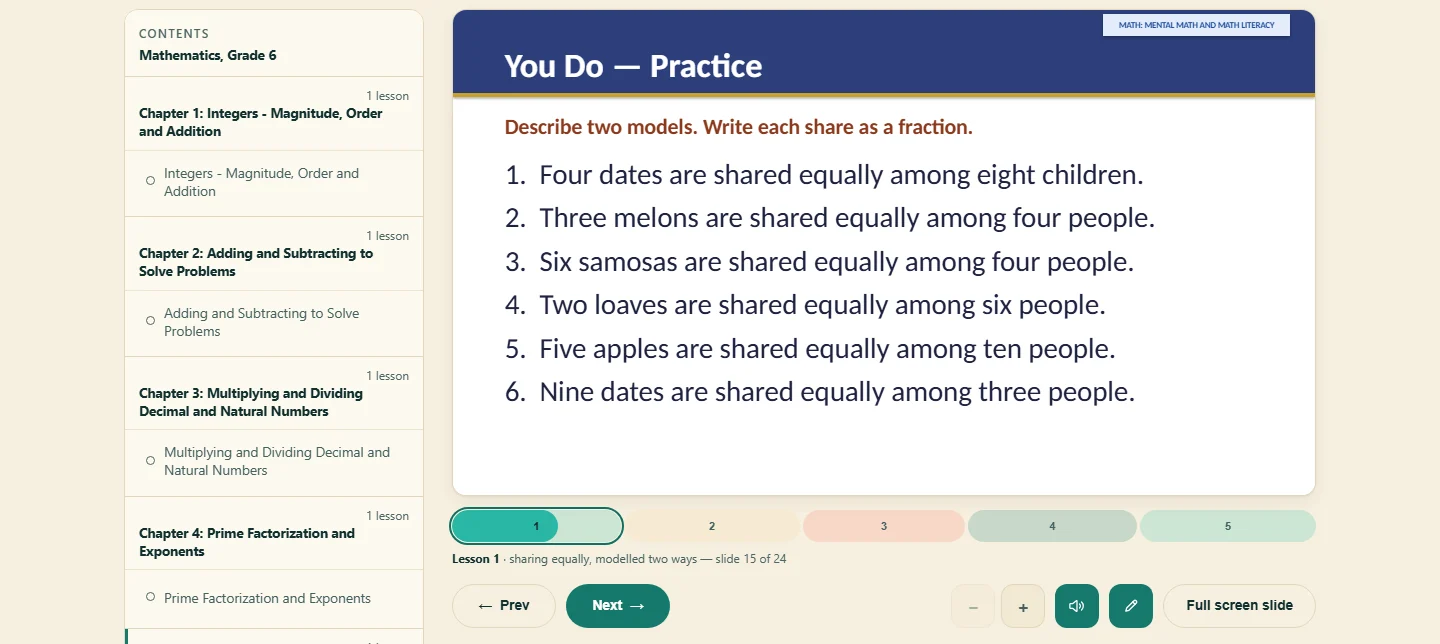
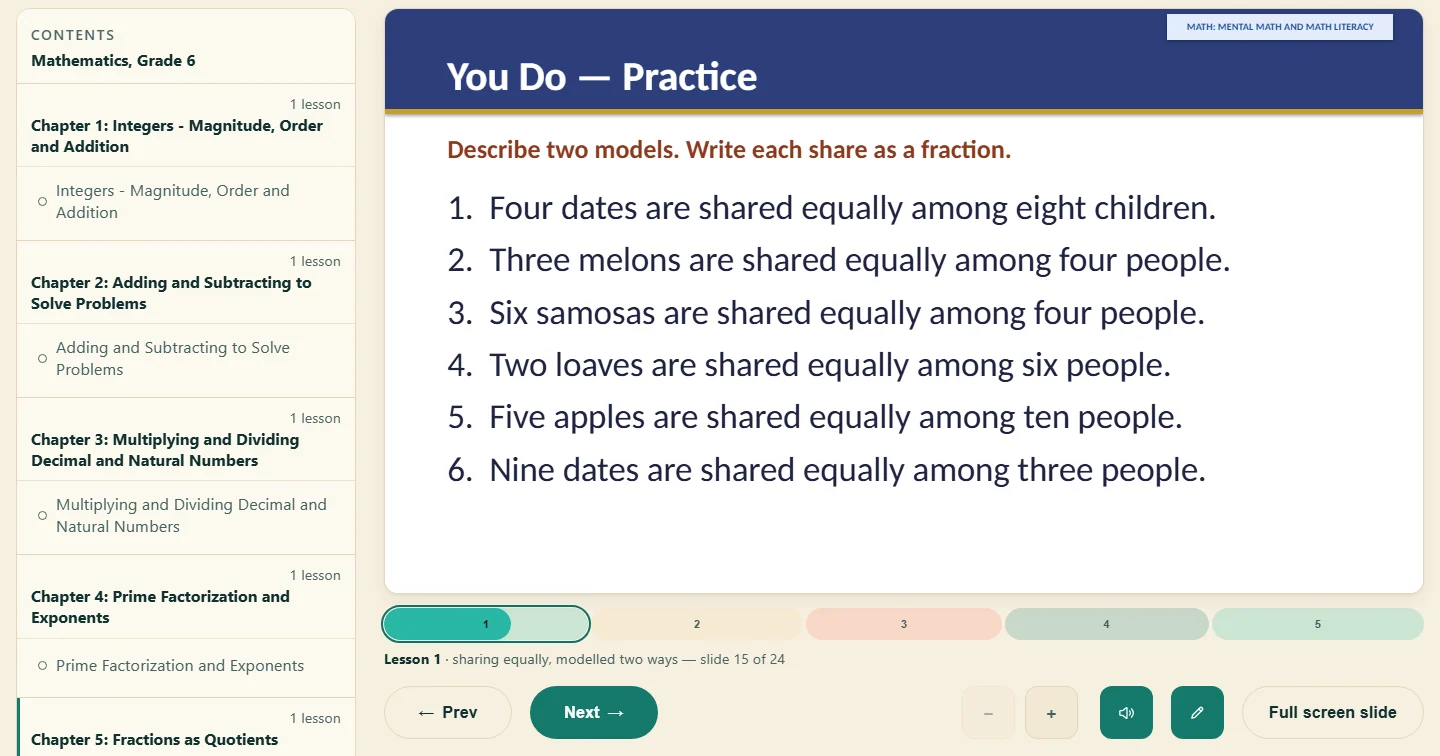
The course opens in our browser-based learning app. These views show a Grade 6 Mathematics example; this course’s own lessons are listed on this page.
A preview
A real slide from Patterns in Place Value. The full deck opens when you enrol. Every slide is watermarked to the account viewing it.
What is inside
Chapter 1: Patterns in Place Value
- Lesson 1The Ones Place at the Centre
- Lesson 2Reading and Writing Numbers to 10 000 000
- Lesson 3Decimals to Thousandths
- Lesson 4Decimals on the Number Line
- Lesson 5Finding a Decimal Between Two Decimals
- Lesson 6Comparing and Ordering Numbers
- Lesson 7Rounding to a Chosen Place
Chapter 2: Adding and Subtracting Whole Numbers and Decimals
- Lesson 1The Standard Algorithm for Addition
- Lesson 2The Standard Algorithm for Subtraction
- Lesson 3Adding Decimals to Thousandths
- Lesson 4Subtracting Decimals to Thousandths
- Lesson 5Estimating to Check a Sum or Difference
- Lesson 6Money Problems
Chapter 3: Divisibility of Natural Numbers
- Lesson 1What Divisibility Means
- Lesson 2Divisibility by 2, 5 and 10
- Lesson 3Divisibility by 3
- Lesson 4Investigating Divisibility by 4, 6, 8 and 9
- Lesson 5Finding Factors, and Why Division by Zero Is Impossible
Chapter 4: Multiplying and Dividing Natural Numbers
- Lesson 1Why the Multiplication Algorithm Works
- Lesson 2Multiplying by a One-Digit Number
- Lesson 3Multiplying by a Two-Digit Number
- Lesson 4Why the Division Algorithm Works
- Lesson 5Dividing by a One-Digit Number
- Lesson 6Remainders: What to Do With What Is Left
- Lesson 7Estimating Products and Quotients
Chapter 5: Improper Fractions and Mixed Numbers
- Lesson 1Counting Beyond One in Unit Fractions
- Lesson 2Improper Fractions
- Lesson 3Mixed Numbers
- Lesson 4From Improper Fraction to Mixed Number
- Lesson 5From Mixed Number to Improper Fraction
- Lesson 6Comparing to the Benchmarks 0, 1/2, 1 and 2
Chapter 6: Adding and Subtracting Fractions with Common Denominators
- Lesson 1Building Wholes from Unit Fractions
- Lesson 2Adding Fractions with the Same Denominator
- Lesson 3Subtracting Fractions with the Same Denominator
- Lesson 4Adding and Subtracting Improper Fractions
- Lesson 5Adding and Subtracting Mixed Numbers
- Lesson 6Choosing a Strategy and Solving Problems
Chapter 7: Ratios, Fractions, Decimals and Percentages
- Lesson 1What a Ratio Compares
- Lesson 2Part-Part Ratios
- Lesson 3Part-Whole Ratios
- Lesson 4The Same Relationship Four Ways
- Lesson 5Percentages as Ratios Out of 100
Chapter 8: Numerical and Algebraic Expressions
- Lesson 1Numerical Expressions and Parentheses
- Lesson 2The Order of Operations
- Lesson 3Variables: Letters for Unknown Values
- Lesson 4Writing Products and Quotients with Variables
- Lesson 5Terms, Coefficients and Constants
- Lesson 6Evaluating an Algebraic Expression
- Lesson 7Writing Equations for Situations
- Lesson 8Solving Equations with Inverse Operations
Chapter 9: Symmetry as a Geometric Property
- Lesson 1Reflection Symmetry in 2-D Shapes
- Lesson 2Reflection Symmetry in 3-D Shapes
- Lesson 3Rotation Symmetry and Order of Rotation
- Lesson 4Central Symmetry: the Half Turn
- Lesson 5Symmetry in Nature and in Indigenous Designs
- Lesson 6Regular Polygons and the Circle
Chapter 10: Location on a Coordinate Grid
- Lesson 1Coordinates and the Coordinate Grid
- Lesson 2Plotting a Point from Its Coordinates
- Lesson 3Naming the Coordinates of a Point
- Lesson 4Describing One Point in Relation to Another
- Lesson 5Polygons on the Coordinate Grid
Chapter 11: Area in Standard Units
- Lesson 1From Length to Area: the Square Unit
- Lesson 2Square Centimetres, Metres and Kilometres
- Lesson 3Converting Between Square Units
- Lesson 4Choosing and Justifying the Unit
- Lesson 5Estimating Area with Benchmarks
- Lesson 6Area of a Rectangle from Its Side Lengths
- Lesson 7Same Area, Different Perimeter
Chapter 12: Arithmetic Sequences - Position and Term
- Lesson 1Position and Term
- Lesson 2Tables of Values
- Lesson 3Graphing a Sequence
- Lesson 4Describing the Rule in Words
- Lesson 5Writing the Rule as an Algebraic Expression
- Lesson 6Missing Terms and Problem Solving
Chapter 13: Frequency and Mode in Categorical Data
- Lesson 1Frequency: Counting Categories
- Lesson 2Frequency Tables
- Lesson 3The Mode
- Lesson 4No Mode, One Mode, Several Modes
- Lesson 5Closed-List and Open-Ended Questions
- Lesson 6Representing Frequency
Before you enrol
How do I get access?
Courses are licensed to schools and home-school programs — by grade, by subject, or the whole catalogue. Teachers and students enrol through their institution’s licence, and anyone can read a course page and its sample slides without one. If your school or home-school program is not on RISE yet, request a proposal. No card is collected anywhere. Inside a course nothing is timed: enrolment keeps one progress pointer on your account, so a course paused in November picks up exactly where it stopped.
Is there a record of completion?
Your account keeps a per-chapter record of what you have completed, which you can see any time in the portal. These courses are self-directed study; they do not carry accreditation, credit, or institutional approval.
Can I show the slides to my class?
Yes — projecting the decks to your own class from your own account is exactly what they are for. Every slide is watermarked to the account viewing it, so share your screen, not exported copies.
Will it work on a school network?
The portal is an ordinary website over standard HTTPS — no downloads, no plugins, no video CDN. If your school filter blocks it, ask IT to allow resourcesforislamicschools.com; the preview on this page is a quick way to test.
Ready to teach from it?
Opened through your institution’s licence. Nothing inside a course is timed.