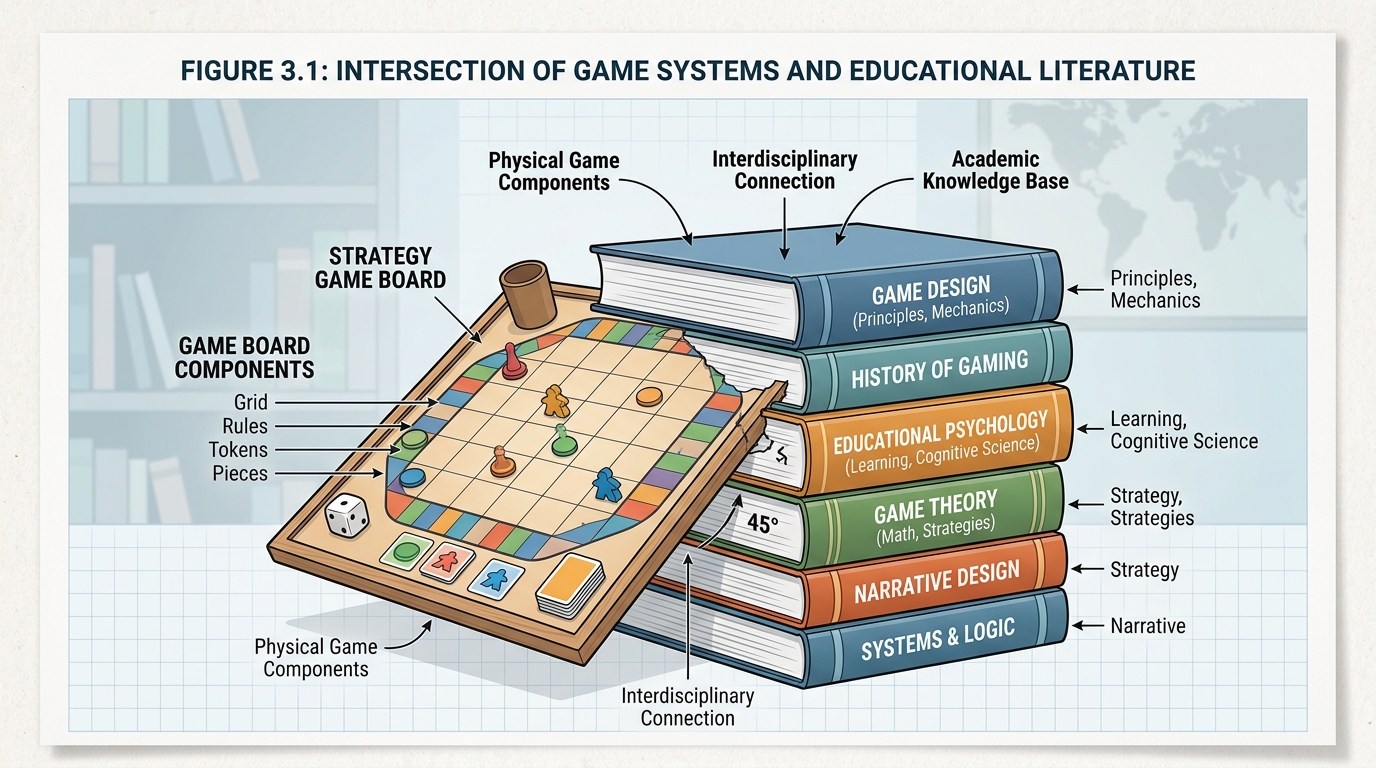
Picture a Friday evening. One phone is propped against the fruit bowl, a nine-year-old is arguing with her grandfather about which came first, the Hijrah or the boycott, and nobody at the table would describe what is happening as revision. It is, though. That evening is the whole idea behind Qur’an Adventure, and this post is about why we built it that way, and what the evidence says about whether it works.
The short version: games can teach, gamification can backfire, and the difference between the two is mostly a design decision made before a single question is written.
Chocolate-covered broccoli

In 1999, Amy Bruckman gave a talk at the Game Developers Conference titled “Can educational be fun?”. Her complaint was that most educational software treated fun as a sugar coating over an educational core, which made about as much sense as chocolate-dipped broccoli. Children can taste the broccoli. They always can.
A decade later, Habgood and Ainsworth tested that instinct properly. They built two versions of a maths game called Zombie Division: one where the arithmetic was the fighting, and one where the same arithmetic was bolted on between the fun bits. In the same amount of playing time, children learned more from the integrated version, and when they were allowed to choose which to play, they chose it by a wide margin (Habgood & Ainsworth, 2011). The learning has to be the game, not the toll you pay to reach it.
That is the line we hold to. If a game only works because a teacher has assigned it, it is a worksheet with animations.
What the research actually says
It is easy to find a slide deck claiming games transform learning. The meta-analyses are more measured, and more useful.
Wouters and colleagues pooled 77 studies and found that serious games beat conventional instruction on learning by a small margin (d = 0.29). The gains were larger when the game was played across several sessions, when it was paired with other instruction, and when it was played in groups rather than alone (Wouters et al., 2013). Clark, Tanner-Smith and Killingsworth found something similar for school-age digital games (g = 0.33), and, more interestingly, that a well-designed version of a game outperformed a standard version by roughly the same margin (g = 0.34). The design choices inside a game mattered as much as the choice to use a game at all (Clark et al., 2016).
Then there is gamification, which is a different thing. Deterding and colleagues defined it as “the use of game design elements in non-game contexts” (Deterding et al., 2011): the points, badges and leaderboards that get sprinkled onto an activity that is not a game. Sailer and Homner’s meta-analysis found small positive effects on knowledge (g = 0.49), motivation (g = 0.36) and behaviour (g = 0.25), but the motivational and behavioural effects were the least stable, and they were strongest when the gamification came with a story and with other people, especially competition combined with collaboration (Sailer & Homner, 2020).
And the sprinkles can go wrong. Hanus and Fox followed 71 university students over a sixteen-week course; half got a leaderboard and badges, half got the same course without them. The gamified group ended up less motivated, less satisfied and feeling less capable, and their final exam scores were lower, with the drop running through the loss of intrinsic motivation (Hanus & Fox, 2015).
Why rewards can backfire
The mechanism behind that result is older than gamification. Deci, Koestner and Ryan reviewed 128 experiments and found that expected, tangible rewards reliably undermined how much people kept at an activity they had previously enjoyed once nobody was making them, and that the effect was worse for children than for university students. Positive feedback, on the other hand, increased interest (Deci, Koestner & Ryan, 1999). Tell a child what she got right and she leans in. Pay her for it and she starts asking what it is worth.
Self-determination theory explains why. People stay motivated when three needs are met: competence, autonomy and relatedness (Ryan & Deci, 2000). A leaderboard threatens competence for everyone below the top three. A mandatory daily login attacks autonomy. And a solo app on a phone in a bedroom offers no relatedness at all. Badly gamified learning manages to miss all three.
The quiet part: quiz games are retrieval practice
There is one more piece of evidence, and it is the one that makes the whole approach worthwhile rather than merely harmless.
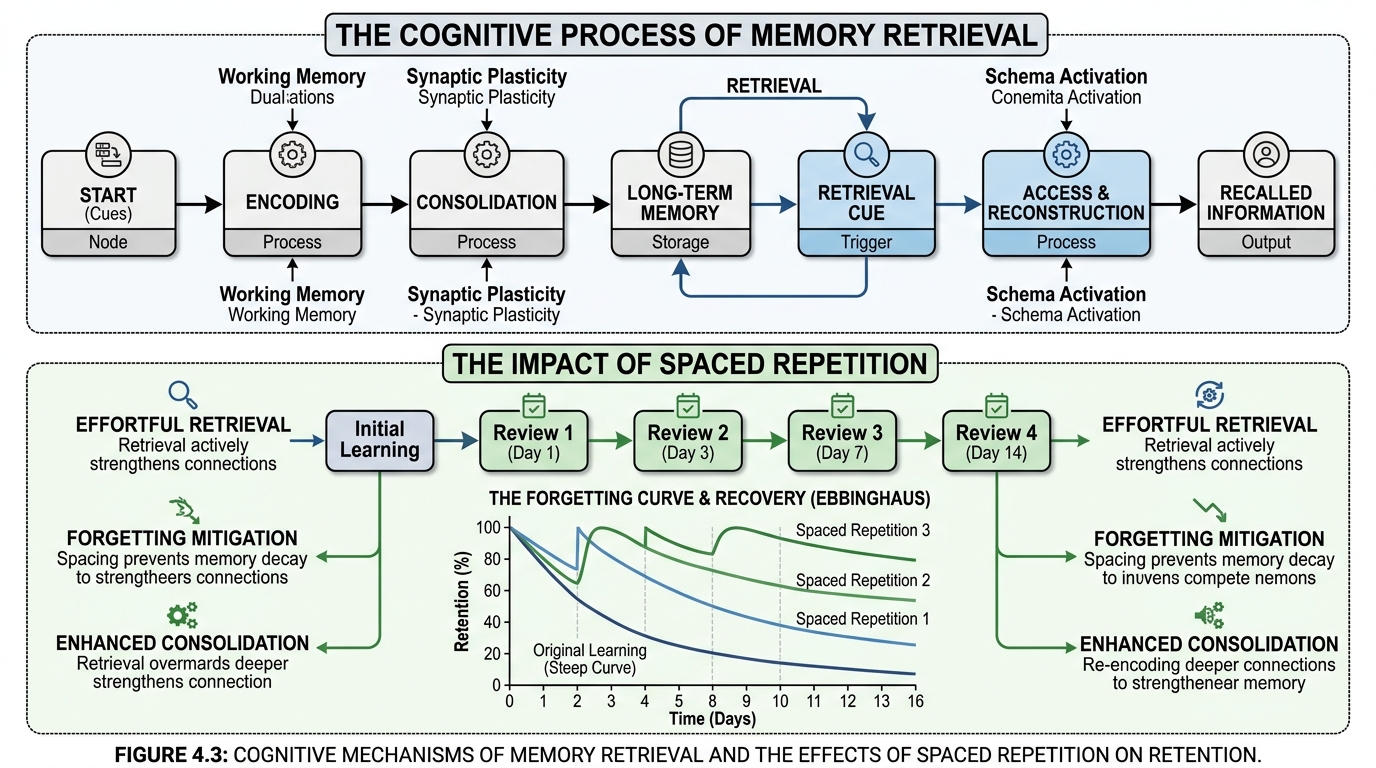
Roediger and Karpicke had students read short passages and then either re-read them or take a recall test. Five minutes later, the re-readers remembered more. A week later, the tested group remembered substantially more, even though the re-readers had been more confident (Roediger & Karpicke, 2006). Being asked a question you have to dig for is a better way to remember than reading the answer again. This is the testing effect, and a trivia round is nothing but testing.
Add spacing. Cepeda and colleagues synthesised 839 comparisons and found that spreading practice out beats cramming it together, and that the best gap between sessions grows with how long you want to remember something (Cepeda et al., 2006). A few questions a day, every day, is the schedule the memory literature would prescribe. It also happens to be the schedule that games have arrived at on their own.
The principles we built to
Put those findings together and the design brief writes itself.
- Play is the goal; learning is the by-product. The knowledge lives inside the mechanic, not beside it. If a game would still be fun with the Islamic content removed, the content is not doing its job.
- Short daily loops. One puzzle a day, six questions a day, six words a day. Small, spaced, finished before anyone is bored.
- Discussion first. In a room, every answer should open a conversation rather than close one. The learning that sticks is what gets said out loud afterwards.
- Retrieval over recognition. Where the mechanic allows it, make players produce the answer rather than spot it in a list.
- No gate on play. Nothing is locked behind an account, a streak or a rank. Extrinsic scaffolding is optional and stays out of the way.
How that looks in the games
Qur’an Adventure Trivia is the game night from the opening paragraph: one device runs the room, teams take turns, and every answer comes with the conversation that follows it. That is Wouters’s group play, Sailer and Homner’s competition-plus-collaboration, and Ryan and Deci’s relatedness in a single format. It is deliberately not a phone-per-person quiz.
Kalima Guesser gives you six guesses at a word drawn from the Qur’an, Hadith and Sirah, in English or Arabic, with a hint and a fact behind every answer. The guessing is the retrieval; the fact is the positive feedback Deci’s review found helpful.
Rise Timeline asks you to put the events of the Seerah back in the order they happened. Sequencing is hard to fake and easy to argue about, which is exactly what you want at a table.
Names Match turns two cards to match one of the Names of Allah to its meaning. It is a memory game in the literal sense: the mechanic is recall.
Daily Crossword is Qur’anic vocabulary, one puzzle a day, and everybody gets the same one, so the staff room and the family group chat can compare notes. Verse Builder is a daily walk through one short surah with the ayah sitting at the top in Arabic, whole and untouched. Letter Hop, for ages five to eight, delivers six words a day as stepping stones with their letters out of order. Garden of Knowledge turns six questions a day into light, and light grows a garden that keeps growing. All four are the short daily loop, in four different moods.
For classrooms there are the room games: Light Grid, Mosaic, In Order, The Locked Library and Meaning Bingo. One screen the whole room watches, and every phone in the room is a controller. Nobody installs anything. The teacher’s job is to run the room, not the software.
Signing in is optional and never gates a game. It does one thing: your saves, streaks and rankings follow you across devices.
That line is on the front page of quranadventure.com because it is the last principle made concrete. Every game is fully playable signed out; accounts are for adults and educators who want continuity. Streaks and rankings exist, because some people enjoy them, but they sit behind a door that a child never has to open.
An honest caveat
None of this makes a game a curriculum. The meta-analyses are clear that games work best alongside other instruction, not instead of it, and the effects are small-to-moderate rather than miraculous. A trivia night will not teach the Seerah on its own. What it will do is make the Seerah something a family argues about happily, and give a child a reason to come back to the same facts tomorrow, spaced a day apart, retrieved rather than re-read.
Which is to say: the studying is real. It is just wearing a disguise.
Sources
- Cepeda, N. J., Pashler, H., Vul, E., Wixted, J. T., & Rohrer, D. (2006). Distributed practice in verbal recall tasks: A review and quantitative synthesis. Psychological Bulletin, 132(3), 354–380. https://doi.org/10.1037/0033-2909.132.3.354
- Clark, D. B., Tanner-Smith, E. E., & Killingsworth, S. S. (2016). Digital games, design, and learning: A systematic review and meta-analysis. Review of Educational Research, 86(1), 79–122. https://doi.org/10.3102/0034654315582065
- Deci, E. L., Koestner, R., & Ryan, R. M. (1999). A meta-analytic review of experiments examining the effects of extrinsic rewards on intrinsic motivation. Psychological Bulletin, 125(6), 627–668. https://doi.org/10.1037/0033-2909.125.6.627
- Deterding, S., Dixon, D., Khaled, R., & Nacke, L. (2011). From game design elements to gamefulness: Defining “gamification”. Proceedings of the 15th International Academic MindTrek Conference, 9–15. https://doi.org/10.1145/2181037.2181040
- Habgood, M. P. J., & Ainsworth, S. E. (2011). Motivating children to learn effectively: Exploring the value of intrinsic integration in educational games. Journal of the Learning Sciences, 20(2), 169–206. https://doi.org/10.1080/10508406.2010.508029
- Hanus, M. D., & Fox, J. (2015). Assessing the effects of gamification in the classroom: A longitudinal study on intrinsic motivation, social comparison, satisfaction, effort, and academic performance. Computers & Education, 80, 152–161. https://doi.org/10.1016/j.compedu.2014.08.019
- Roediger, H. L., & Karpicke, J. D. (2006). Test-enhanced learning: Taking memory tests improves long-term retention. Psychological Science, 17(3), 249–255. https://doi.org/10.1111/j.1467-9280.2006.01693.x
- Ryan, R. M., & Deci, E. L. (2000). Self-determination theory and the facilitation of intrinsic motivation, social development, and well-being. American Psychologist, 55(1), 68–78. https://doi.org/10.1037/0003-066X.55.1.68
- Sailer, M., & Homner, L. (2020). The gamification of learning: A meta-analysis. Educational Psychology Review, 32(1), 77–112. https://doi.org/10.1007/s10648-019-09498-w
- Wouters, P., van Nimwegen, C., van Oostendorp, H., & van der Spek, E. D. (2013). A meta-analysis of the cognitive and motivational effects of serious games. Journal of Educational Psychology, 105(2), 249–265. https://doi.org/10.1037/a0031311