Every teacher of grade four or five has met this child. She reads aloud beautifully. Her pace is steady, her word attack is sound, and the running record says she is exactly where she should be. Then you ask her why the character in the story did what he did, and you get the sentence read back to you, word for word.
A child can decode every word on a page and still miss what it says.
— Dr. Shameeza Khan
That sentence is not a lament. It is a description of something reading research has been mapping for forty years, and the map is clear enough that a teacher can act on it.
Two things, multiplied
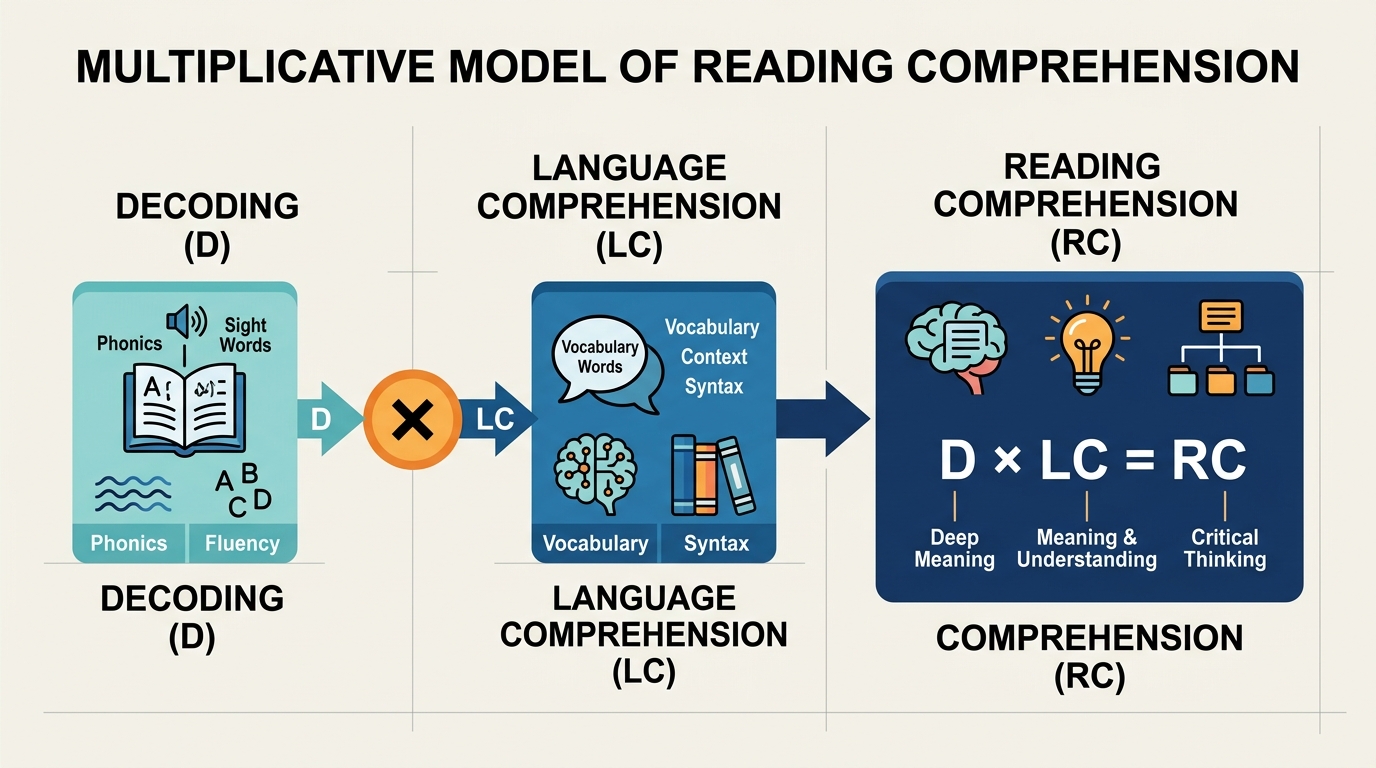
In 1986, Philip Gough and William Tunmer proposed what they called the Simple View of Reading. Reading comprehension, they argued, is the product of two things: decoding (turning print into words) and language comprehension (making sense of those words once you have them). The paper posited three kinds of reading difficulty, one from weak decoding, one from weak comprehension, and one from both (Gough & Tunmer, 1986).
The word product matters. Gough and Tunmer did not say decoding plus comprehension; they said decoding times comprehension. If either factor is near zero, so is the result, and a child who is strong on one and weak on the other is not “half a reader.” Wesley Hoover and Gough tested this in a longitudinal sample of English–Spanish bilingual children from grade one to grade four, and found that adding the product term to a model of reading comprehension improved its predictions significantly beyond what the two components did on their own (Hoover & Gough, 1990).
For a classroom teacher the practical reading of this is blunt. When a fluent decoder is not understanding, the problem is on the language side: vocabulary, background knowledge, sentence structure, inference. More phonics will not help her. More words she can read but does not know will not help her either.
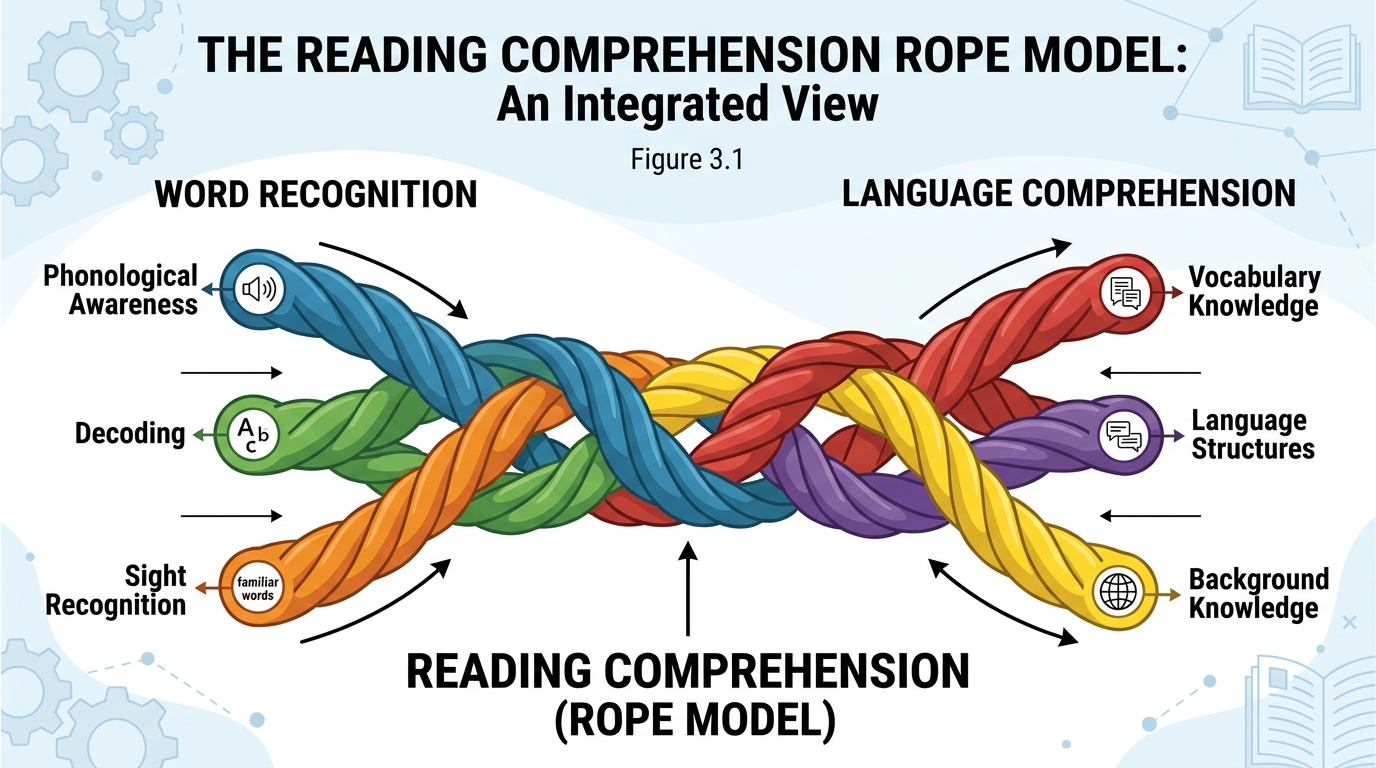
Hollis Scarborough’s Reading Rope, published in 2001, gives the same idea a more detailed picture. It draws skilled reading as two bundles of strands twisting together: a word-recognition bundle (phonological awareness, decoding, sight recognition) that becomes increasingly automatic, and a language-comprehension bundle (background knowledge, vocabulary, language structures, verbal reasoning, literacy knowledge) that becomes increasingly strategic (Scarborough, 2001). Our fluent decoder has a strong lower rope and a thin upper one.
Why it shows up in grade four
Jeanne Chall spent much of her career describing how reading changes as children move through school, and one of her findings has a name teachers recognize instantly: the fourth-grade slump.
The study behind the name followed thirty children from low-income families across grades two to seven, testing them on word recognition, word meaning, spelling, oral reading and silent comprehension. Through grade three they scored much like the normative population. Around grade four their scores began to fall behind, and the first and steepest decline was in word meaning: about a year behind at grade four, more than two years behind by grade seven. Oral reading and comprehension held for a while and then declined too, around grades six and seven (Chall & Jacobs, 2003).
Chall and Jacobs are careful about the sequence. The vocabulary lag did not hurt comprehension at first; the children compensated using context, and the strategy worked until the texts contained too many words they did not know. That is the transition from learning to read to reading to learn. Primary texts are written with familiar words about familiar things. From grade four onward the words are less common, the ideas more abstract, and the text expects you to bring something to it.
What the reader brings

The best-known demonstration of what the reader brings is a baseball game.
Donna Recht and Lauren Leslie took sixty-four grade seven and eight students and sorted them by reading ability (above the 70th percentile or below the 30th) and by how much they knew about baseball. Each student read an account of half an inning, then re-enacted it with figures on a model field, retold it, and later summarized it. Knowledge of baseball was the powerful factor, and it did not interact with reading ability. In the authors’ words, students with high reading ability but little baseball knowledge “were no more capable of recall or summarization than were students with low reading ability and low knowledge of baseball,” while the summaries of weak readers who knew the game were far superior to those of strong readers who did not (Recht & Leslie, 1988).
They note a limit themselves: baseball is a familiar topic for most children, and strong general reading skill may matter more with less familiar material. But the study is a clean illustration of the Simple View from the language side. Decoding was never the problem for any of those sixty-four students.
Daniel Willingham’s account of why knowledge helps is the one we hand to new teachers. Writers leave out most of what they mean, on the assumption that readers can fill the gaps; a reader who knows the topic fills them without noticing, and a reader who does not either stalls or invents. Knowledge also lets a reader chunk information, so that working memory is not used up holding pieces together, and it gives new information something to attach to, so more of it stays (Willingham, 2006).
What strategy instruction can and cannot do
None of this means comprehension strategies are a waste of time. The National Reading Panel reviewed the research and found solid evidence for a set of them: comprehension monitoring, cooperative learning, graphic and semantic organizers, question answering, question generation, story structure and summarization, with the strongest results coming from teaching a combination rather than any single one. It also found that teachers need extensive, explicit preparation to teach them well (National Reading Panel, 2000).
The question is how much time to give them. Willingham and Gail Lovette reviewed eight quantitative syntheses of strategy instruction, covering typically developing children and children with reading difficulties, and found that none of them showed extended practice beating brief instruction. Their summary: “Ten sessions yield the same benefit as fifty sessions.” Their conclusion is that strategy instruction should be explicit and brief, and that the time saved belongs to vocabulary, deep content and wide reading across genres, because strategy instruction has an upper limit and background knowledge does not (Willingham & Lovette, 2014).
Recht and Leslie had said something similar decades earlier: strategies and the knowledge base “should be equally considered in the design of instruction.” The field has spent a long time weighting the first. The evidence says to rebalance.
Five moves for a grade 4–6 classroom
What follows is what we would do with a class of nine- to twelve-year-olds who decode well and comprehend unevenly.
- Build knowledge in coherent units, not scattered passages. A 2022 meta-analysis of thirty-five studies from kindergarten to grade five found that integrating literacy instruction with science and social studies content produced large gains in vocabulary (effect size 0.91) and content knowledge (0.89), and meaningful gains in comprehension (0.40 overall, 0.25 on standardized measures) (Hwang, Cabell & Joyner, 2022). Three weeks of texts on one topic beats fifteen unrelated ones, because each text makes the next one easier to read.
- Teach vocabulary inside those units. The National Reading Panel’s vocabulary findings are practical: pre-teaching words before a text helps, repeated exposure across varied contexts helps, and a good deal of vocabulary is learned incidentally through storybook reading and listening. A word met in five texts about the same topic is a word a child owns.
- Read aloud above their decoding level. In the Simple View, language comprehension is the other factor, and it can grow ahead of decoding. A read-aloud lets a class meet sentence structures, words and ideas that their own reading would not reach for another two years, and it costs nothing in decoding effort.
- Ask questions the text does not answer directly. Literal questions reward retrieval. Inference questions (“Why did he say that? What must have happened between these two paragraphs?”) make the gap-filling visible, and they show you which children are filling gaps and which are reading words. Model your own inferences aloud; the how is what they are missing.
- Have them write about what they read. Graham and Hebert’s meta-analysis for the Carnegie Corporation found that writing about a text (extended responses, summaries, notes, questions) improved comprehension of it with an average effect size of 0.40, and 0.63 across twelve studies of lower-achieving students, though only when those students were explicitly taught how to do the writing task (Graham & Hebert, 2010). Writing forces a reader to decide what the text meant.
Where an Islamic school starts ahead
Every move on that list depends on shared knowledge, and shared knowledge is the one thing an Islamic school has in abundance.
Your grade five class already knows the story of Prophet Yusuf, peace be upon him: the dream, the brothers, the well, the prison, the years of plenty and famine, the reunion. They know the characters, the setting and the moral weight of every turn. That is a complete knowledge base, and it is the Recht and Leslie baseball field. A child who struggles with an unfamiliar passage about a stranger in a strange country can read a passage about Yusuf in Egypt and make every inference, because she is not building the schema and the meaning at the same time.
That is where comprehension instruction can begin: with inference questions on stories the children already hold, with vocabulary drawn from texts they care about, with writing about narratives they can retell from memory. Once they have practised the act of comprehending on familiar ground, the same moves transfer to the science unit and the novel study. RISE’s Reading and Writing with Purpose series is built on that idea, but the idea does not belong to us; it belongs to anyone who has ever watched a child’s face change when the story is one they know.
The fluent decoder who cannot tell you why the character did what he did is not a mystery. She has one strong rope and one thin one, and the thin one is made of words and knowledge. Both can be taught.
Sources
- Gough, P. B., & Tunmer, W. E. (1986). Decoding, reading, and reading disability. Remedial and Special Education, 7(1), 6–10. ERIC EJ331572 · doi:10.1177/074193258600700104
- Hoover, W. A., & Gough, P. B. (1990). The simple view of reading. Reading and Writing: An Interdisciplinary Journal, 2(2), 127–160. ERIC EJ477349 · doi:10.1007/BF00401799
- Scarborough, H. S. (2001). Connecting early language and literacy to later reading (dis)abilities: Evidence, theory, and practice. In S. B. Neuman & D. K. Dickinson (Eds.), Handbook of Early Literacy Research (Vol. 1, pp. 97–110). Guilford Press. Publisher contents
- Chall, J. S., & Jacobs, V. A. (2003). The classic study on poor children’s fourth-grade slump. American Educator, 27(1). AFT
- Recht, D. R., & Leslie, L. (1988). Effect of prior knowledge on good and poor readers’ memory of text. Journal of Educational Psychology, 80(1), 16–20. ERIC EJ384774 · doi:10.1037/0022-0663.80.1.16
- Willingham, D. T. (2006). How knowledge helps: It speeds and strengthens reading comprehension, learning—and thinking. American Educator, 30(1). AFT
- National Reading Panel (2000). Teaching Children to Read: An Evidence-Based Assessment of the Scientific Research Literature on Reading and Its Implications for Reading Instruction. National Institute of Child Health and Human Development. NICHD findings
- Willingham, D. T., & Lovette, G. (2014). Can reading comprehension be taught? Teachers College Record, 26 September 2014. Author’s copy (PDF)
- Hwang, H., Cabell, S. Q., & Joyner, R. E. (2022). Effects of integrated literacy and content-area instruction on vocabulary and comprehension in the elementary years: A meta-analysis. Scientific Studies of Reading, 26(3), 223–249. ERIC EJ1360566 · doi:10.1080/10888438.2021.1954005
- Graham, S., & Hebert, M. (2010). Writing to Read: Evidence for How Writing Can Improve Reading. A Carnegie Corporation Time to Act report. Alliance for Excellent Education. Report (PDF)